F150 7 Pin vs 4 Pin Trailer Plug Which One Do You Need
Featured image for f150 7 pin vs 4 pin trailer plug
Image source: offroadofficial.com
The crucial decision between an F150’s 7-pin and 4-pin trailer plug hinges entirely on your trailer’s specific power demands and features. A 4-pin connector exclusively handles basic functions like turn signals, brake lights, and running lights, ideal for smaller, unbraked trailers. However, for trailers requiring electric brakes, reverse lights, or auxiliary power for charging and accessories, the 7-pin plug is indispensable, providing those critical additional circuits and expanded functionality.
Hey there, fellow F150 owner! Ever stared at the back of your truck, then at your trailer, and wondered, “Which plug goes where?” You’re definitely not alone. When you’re hooking up a trailer to your F150, you’ll quickly run into the question of an F150 7 pin vs 4 pin trailer plug. Simply put, the one you need depends entirely on what kind of trailer you’re pulling and what functions it requires.
Most F150s come equipped to handle both, often having a 7-pin connector with a 4-pin built-in or readily accessible. But knowing which one is right for your specific haul is key for safety and functionality. Let’s break down the differences so you can hook up with confidence!
What’s the real scoop on the F150 7 pin vs 4 pin trailer plug, and how do I pick the right one for my adventures?
Alright, let’s dive deep into the world of trailer plugs, specifically focusing on the F150 7 pin vs 4 pin trailer plug dilemma. Understanding this is crucial for a smooth and safe towing experience.
First, let’s talk about the 4-Pin Trailer Plug. This is your basic, no-frills connector. Think of it as the minimalist option. It provides the absolute essentials for legal towing:
- Left Turn/Brake Light: Tells drivers behind you when you’re turning left or slowing down.
- Right Turn/Brake Light: Handles your right turns and braking signals.
- Tail/Running Lights: Keeps your trailer visible at night or in low-light conditions.
- Ground: Essential for completing the electrical circuit.
You’ll typically find a 4-pin plug on smaller trailers. Picture a small utility trailer for hauling yard waste, a jet ski trailer, or a basic boat trailer that doesn’t have electric brakes. It’s simple, straightforward, and perfect for lighter loads where all you need are lights. I remember once just needing to haul some furniture on a small rented trailer, and the 4-pin was all that was required. Easy peasy!
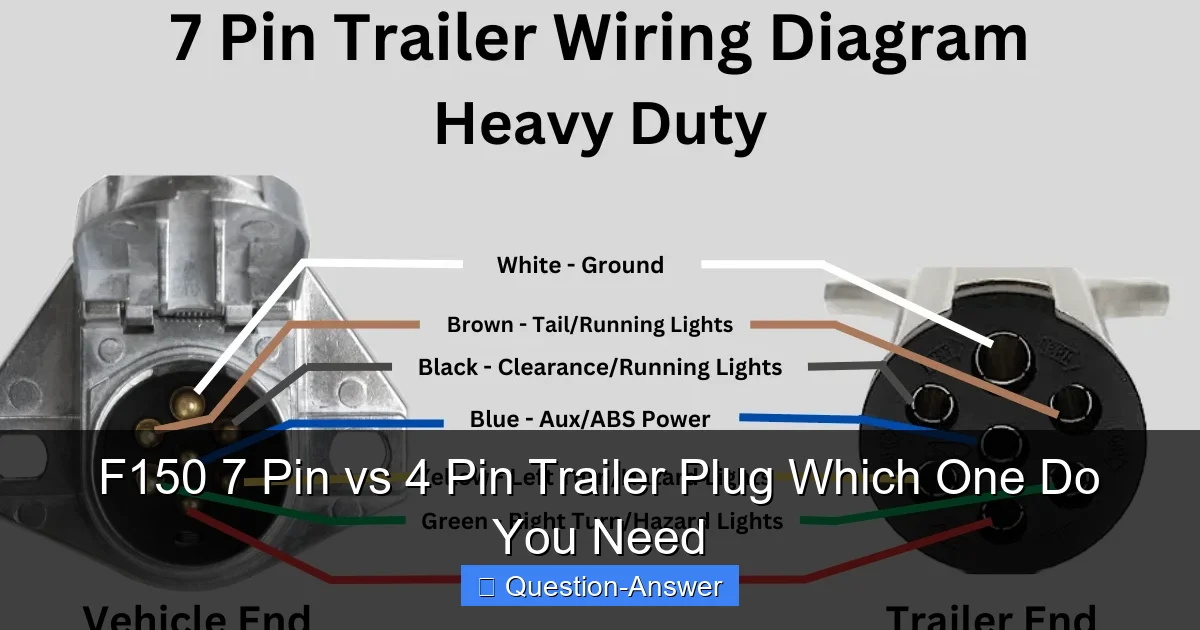
Now, let’s move on to the 7-Pin Trailer Plug. This is the big kahuna, offering much more capability. The core difference between the F150 7 pin vs 4 pin trailer plug becomes really clear here. It includes all the functions of the 4-pin, plus a lot more:
- Left Turn/Brake Light
- Right Turn/Brake Light
- Tail/Running Lights
- Ground
- Electric Trailer Brakes: This is a huge one! For heavier trailers, electric brakes are essential for safe stopping. The 7-pin connector provides the pathway for your F150’s brake controller to activate the trailer’s brakes. Trust me, if your trailer has electric brakes, you NEED a 7-pin connection and a working brake controller. Stopping safely is non-negotiable.
- Auxiliary 12V Power: This constant power supply is super handy! It can charge your trailer’s battery while you drive, perfect for travel trailers that power lights, pumps, or even a refrigerator. It can also be used for other accessories like interior lights on a utility trailer.
- Reverse Lights (or Backup Camera Power): Some trailers have reverse lights, which can be a huge help when backing up at night. This pin also provides power for trailer-mounted backup cameras.
You’ll almost always use a 7-pin plug for larger trailers. Think travel trailers, car haulers, horse trailers, or any heavy-duty utility trailer that features electric brakes. My own travel trailer absolutely requires the 7-pin for the brakes and to keep its battery charged while we’re on the road. It makes a world of difference.
So, Which One Do You Need?
It really boils down to your trailer’s requirements. Look at your trailer. Does it have electric brakes? Does it have a battery that needs charging? If yes to either, you absolutely need a 7-pin setup. If it’s just a small, light trailer for basic hauling, a 4-pin is perfectly fine.
Good news for F150 owners: most modern F150s come standard with a 7-pin connector, often with a 4-pin outlet integrated right into the same housing. This means your F150 is usually ready for anything! If you have a 7-pin on your F150 and a 4-pin on your trailer, you can simply use a readily available adapter. It’s a small dongle that converts the 7-pin female port on your truck to a 4-pin male plug for your trailer. Just remember, an adapter only converts the connection; it doesn’t add features. So, plugging a 4-pin trailer into an F150’s 7-pin via an adapter won’t magically give your trailer electric brakes.
My advice? Always go for the more capable connection if your F150 has it. Even if your current trailer only needs a 4-pin, having the 7-pin ready on your truck gives you flexibility for future towing needs. It’s better to have more capability than not enough.
Choosing between the F150 7 pin vs 4 pin trailer plug doesn’t have to be a headache. Simply assess your trailer’s features and choose the connector that matches its needs. Most F150s are equipped for versatility, making your job easier. Happy towing, and stay safe out there!