F150 Axle Codes Decoder Unlock Your Truck’s Secrets
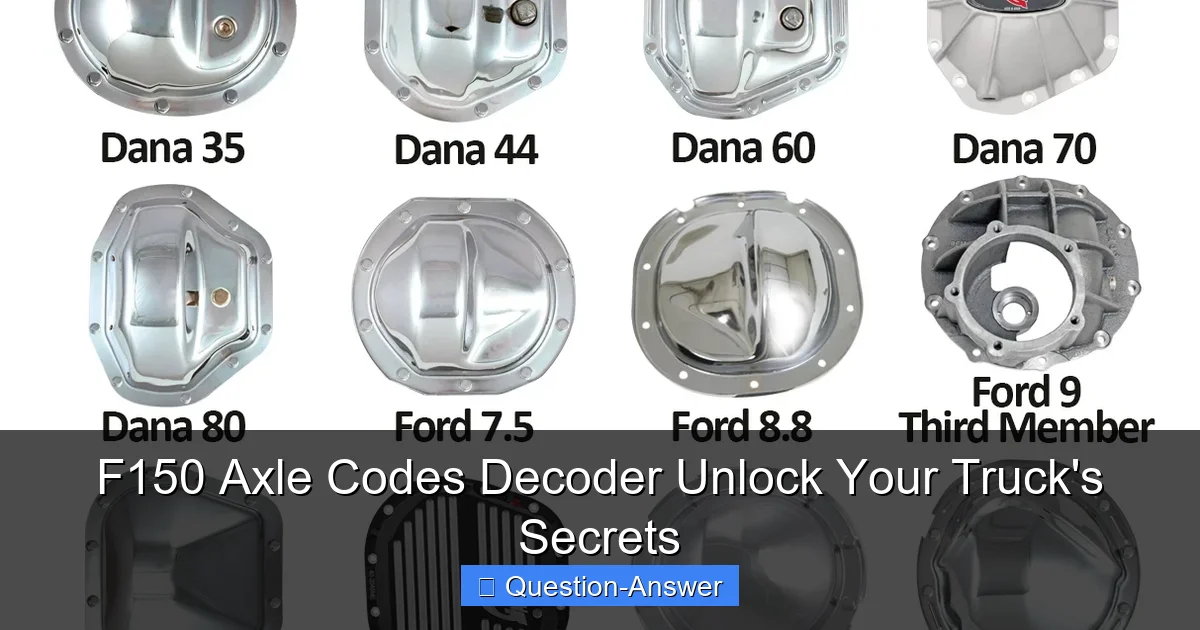
Featured image for f150 axle codes decoder
Image source: onallcylinders.com
Decoding your F150’s axle codes is essential for unlocking crucial information about its drivetrain. These vital codes reveal your truck’s specific gear ratio and differential type, directly impacting its performance, towing capacity, and off-road capabilities. Use an F150 axle codes decoder to understand your truck’s true potential for maintenance, upgrades, and adventure.
F150 Axle Codes Decoder Unlock Your Truck’s Secrets
Hey there, fellow F150 owner! Ever looked at that sticker on your door jamb and wondered what all those letters and numbers really mean? Specifically, those mysterious axle codes? It’s like your truck is trying to tell you something, but it’s speaking in code! Don’t worry, you’re not alone. I’ve been there, staring blankly, trying to figure out if my truck was truly capable of what I needed it to do. Learning how to use an f150 axle codes decoder is a game-changer. It’s like getting a secret key to understand your truck’s true personality and capabilities, from towing power to off-road prowess.
Understanding these codes helps you make informed decisions, whether you’re planning a big tow, thinking about upgrades, or just doing routine maintenance. It literally deciphers some of the most critical mechanical aspects of your F150. Let’s dive in and unlock those secrets together!
So, what exactly are F150 axle codes, and how can I use an f150 axle codes decoder to understand my truck better?
F150 axle codes are specific identifiers found on your truck’s door jamb sticker (sometimes called the “B-pillar” sticker) or in your owner’s manual. These codes reveal crucial information about your truck’s rear axle assembly, mainly its gear ratio and the type of differential it has. Think of it as a fingerprint for your truck’s rear end – unique and very telling!
Using an f150 axle codes decoder basically means translating these alphanumeric codes into plain language. Here’s why that’s so important and how you do it:
What the Codes Tell You:
- Gear Ratio: This is a big one! It determines how many times the driveshaft spins for one rotation of your wheels. A higher number (like 3.73 or 4.10) means more torque at the wheels, which is great for towing and acceleration, but might slightly impact fuel economy. A lower number (like 3.31) is better for highway cruising and fuel efficiency.
- Differential Type: Your differential can be an open differential (standard, sends power to the wheel with least resistance), a limited-slip differential (LSD) (helps both wheels get power for better traction), or an electronic locking differential (e-locker) (can fully lock both wheels together for maximum traction, especially off-road). Knowing this impacts your truck’s performance in different driving conditions.
Where to Find Your Code (Personal Tip!):
The easiest place to find your F150 axle code is on the white sticker on the driver’s side door jamb. Look for the “AXLE” box. It’ll usually be a two-character code, like “H9” or “L3.” I remember when I first found mine, “L9,” I felt like I’d found a secret message!
Using an f150 axle codes decoder (Simple Steps):
Once you have your code, you’ll need to look it up. There are many online charts and resources specific to F150s, usually categorized by model year. Your owner’s manual is also a fantastic, reliable source. I always recommend cross-referencing to be sure. For example, my “L9” code for my 2018 F150 revealed a 3.55 gear ratio with an electronic locking differential. This told me it was perfect for my light towing needs and occasional muddy trails!
Common F150 Axle Code Examples (just to give you a feel):
- 19: Often means a 3.55 Open Differential.
- H9: Typically a 3.55 Limited Slip Differential.
- L9: For newer models, this might indicate a 3.55 Electronic Locking Differential.
- 26: Could be a 3.73 Open Differential.
- B6: Points to a 3.73 Limited Slip Differential.
- L3: For newer models, this could mean a 3.73 Electronic Locking Differential.
(Remember, these are common examples and can vary by year, so always confirm with a specific f150 axle codes decoder chart for your truck’s model year!)
Why This Matters for You:
- Towing: Your gear ratio is critical for understanding your truck’s true towing capacity. When I was looking to tow my small travel trailer, knowing I had 3.55 gears with a locker gave me confidence. A higher ratio offers more grunt.
- Performance & Fuel Economy: A higher gear ratio gives you quicker acceleration but might use more fuel on the highway. A lower ratio saves fuel but might feel less peppy. It’s a balance!
- Maintenance & Parts: If you ever need to replace axle components or even just differential fluid, knowing your exact axle type and ratio is essential. My buddy once almost bought the wrong fluid because he didn’t check his f150 axle code first!
- Off-Roading: If you love hitting the trails, understanding if you have a limited-slip or an e-locker is huge for traction and navigating tough terrain.
Decoding your F150’s axle codes is truly empowering. It gives you a deeper understanding of your truck’s capabilities and helps you make smarter decisions about its care and use. It’s a simple step that yields a ton of valuable information.
So, there you have it! The next time you look at that door jamb sticker, you won’t see a jumble of letters and numbers. You’ll see a clear picture of what makes your F150 tick. Using an f150 axle codes decoder turns a mystery into meaningful data, helping you truly unlock your truck’s secrets and make the most of every mile.