Your F150 Evap Leak Fix A Complete Guide To DIY Repairs
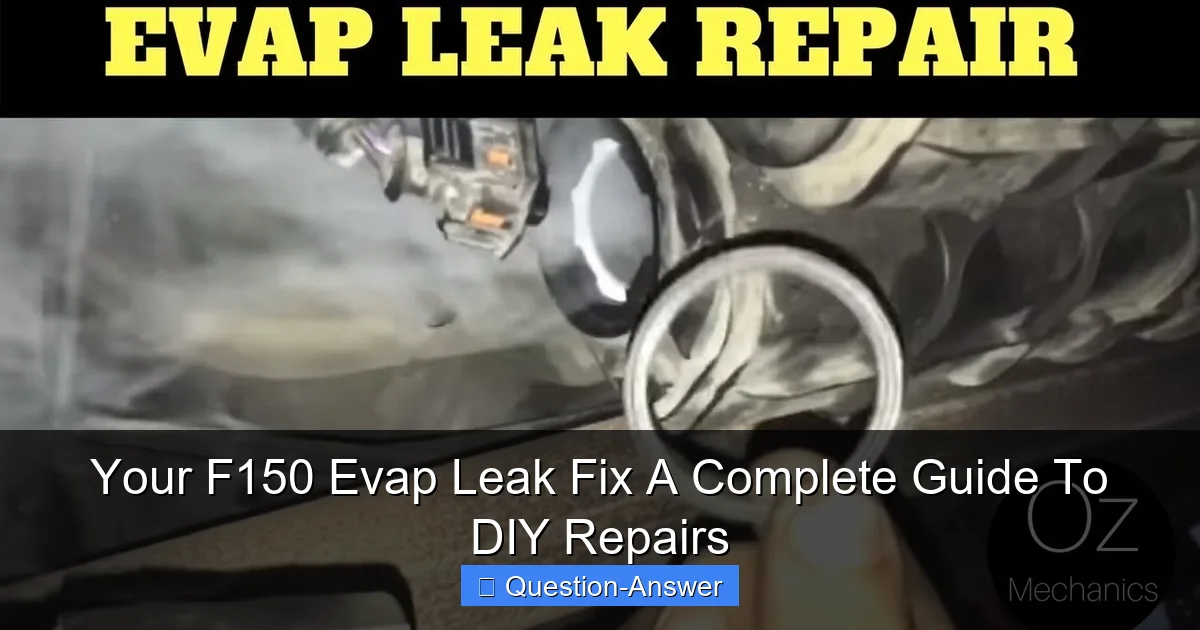
Featured image for f150 evap leak fix
Image source: i.ytimg.com
Fixing your F150 EVAP leak can be a straightforward DIY task with the right guidance. This complete guide provides everything you need to diagnose common symptoms like a ‘check engine’ light or fuel smell, offering step-by-step instructions to pinpoint and repair leaks yourself. Save money and confidently restore your truck’s performance and emissions by tackling this common issue.
Your F150 Evap Leak Fix A Complete Guide To DIY Repairs
Hey there, fellow F150 owner! Ever had that unsettling “Check Engine” light flash on your dash, only for a quick scan to point to an “evap system leak”? Trust me, you’re not alone. This is a super common hiccup for our beloved trucks, and it can feel daunting. But here’s the good news: often, an F150 evap leak fix is something you can tackle right in your driveway, saving you a good chunk of change. Think of it as a little puzzle, and we’re going to solve it together.
I’ve been there, staring at that light, wondering if I just bought a money pit. The truth is, many times it’s a simple, inexpensive repair. This guide will walk you through understanding your EVAP system and finding that pesky F150 evap leak fix without needing a professional mechanic right away. Let’s get your F150 running smoothly and that light off!
So, what’s the deal with an F150 evap leak fix, and how can I tackle it myself?
Alright, let’s dive in! An EVAP system (Evaporative Emission Control System) in your F150 is designed to prevent fuel vapors from escaping into the atmosphere. It’s a closed system, and when it detects a leak, your “Check Engine” light comes on. Finding an F150 evap leak fix often starts with understanding where these leaks commonly occur.
First things first, don’t panic! The most common and easiest F150 evap leak fix is often a simple loose or faulty gas cap. Yes, really! I once had a friend who spent days worrying before realizing his gas cap wasn’t clicked on all the way. Always start here: tighten your gas cap until it clicks multiple times. Drive a bit, and see if the light resets itself. If not, don’t worry, we’re just getting started.
Next up, it’s time for some visual detective work. Get underneath your truck if you can do so safely, or just lift the hood. You’re looking for hoses, especially those connected to the fuel tank, the charcoal canister, the purge valve, and the vent valve. These are typically rubber or plastic lines that can crack, split, or come loose over time. Look for any visible damage. I remember spending an afternoon meticulously checking every hose near my fuel tank after a notorious squirrel decided it was a chew toy. Sometimes, the damage is subtle, like a small crack that’s hard to spot.
Two common culprits for an F150 evap leak fix, beyond the gas cap, are the purge valve and the vent valve (or canister vent solenoid). The purge valve is usually under the hood, near the intake manifold. It’s an electronic valve that can stick open or closed. You might hear a clicking sound from it or test it with a multimeter if you’re comfortable. The vent valve is typically located near the charcoal canister, often close to the fuel tank. This valve controls airflow in and out of the canister. Both can fail, leading to an evap leak.
How do you test them without fancy tools? For the purge valve, you can sometimes disconnect the vacuum line while the engine is running and see if you feel vacuum. If it’s stuck open, you’ll feel vacuum. For the vent valve, a common issue is it gets clogged with dirt or dust, preventing it from sealing properly. You can often remove and visually inspect it. Some folks try cleaning it, but replacement is usually the most reliable F150 evap leak fix for a faulty valve.
If you’ve checked the gas cap, visually inspected hoses, and considered the purge and vent valves, but the light is still on, you might be dealing with a more elusive leak. This is where a smoke test comes in, which is often done by mechanics. They inject smoke into the EVAP system and watch for it to escape from any leaks. While you can rent smoke testers, it might be a step to consider professional help if you’re not comfortable. My buddy swore by an old trick using a cigar and a bicycle pump for a DIY smoke test, but I wouldn’t personally recommend that! Safety first, always.
Remember, when performing any of these checks, always ensure your truck is on a level surface and cool. Wear appropriate safety gear. The ultimate F150 evap leak fix is often a blend of patience, careful observation, and a willingness to get a little dirty.
So, there you have it! Don’t let that “Check Engine” light intimidate you. An F150 evap leak fix is often a solvable problem with a bit of elbow grease and a methodical approach. Start with the simplest solutions, work your way through the common culprits, and most likely, you’ll find the issue and get your F150 back to its prime. And if you do hit a wall, there’s no shame in calling in a pro. Happy wrenching!