Where is Your F150 Starter Relay Location A Simple Guide
Pinpointing your F-150 starter relay is key to a functioning ignition system. You’ll typically find it located in the under-hood Power Distribution Box, often identified as relay R02 or similar, depending on your model year. Always consult your specific F-150’s owner’s manual or the fuse box diagram for the precise location and effortless replacement.
Picture this: It’s early morning, you’re running a bit late, and you hop into your trusty Ford F150, turn the key, and… nothing. Maybe you hear a disheartening click, or perhaps absolute silence. That sinking feeling in your stomach is all too familiar for many truck owners. While a non-starting F150 can feel like a major disaster, often the culprit is something surprisingly simple and inexpensive to fix: the starter relay.
Your F150 is a workhorse, designed to handle tough jobs and get you where you need to go. But like any complex machine, it has small components that can wear out. The starter relay is one of those unsung heroes. If you’ve ever found yourself stranded, wondering why your powerful truck won’t crank, understanding the f150 starter relay location is your first step towards getting back on the road without calling a tow truck or a costly mechanic.
This guide is designed to be your friendly co-pilot, helping you understand what the starter relay does, identify its common symptoms when it fails, and most importantly, pinpoint its exact f150 starter relay location in various models. We’ll walk through how to find it, test it, and even replace it yourself, transforming that “click of dread” into a satisfying roar.
Key Takeaways
- Locate PDB: Find your F150’s Power Distribution Box under the hood.
- Use Diagram: Consult the PDB lid diagram or owner’s manual.
- Identify Relay: Pinpoint the correct starter relay slot or number.
- Simple Test: Swap the suspect relay with a known good, identical one.
- Key Diagnostic: This is a primary diagnostic for F150 no-start issues.
- Safety First: Always disconnect the battery before working with electrical.
📑 Table of Contents
- Understanding the F150 Starter Relay: What It Does and Why It Matters
- General F150 Starter Relay Location: The Fuse Box is Your Friend
- Pinpointing Your F150 Starter Relay Location by Generation
- How to Confirm and Test Your F150 Starter Relay
- Replacing Your F150 Starter Relay: A Quick Fix
- What to Do If Your F150 Still Won’t Start
Understanding the F150 Starter Relay: What It Does and Why It Matters
Before we dive into the specific f150 starter relay location, let’s chat for a moment about what this little component actually does. Think of it as a crucial gatekeeper in your truck’s starting system.
The Role of the Starter Relay
When you turn your ignition key, you’re not directly sending a huge jolt of power to the starter motor. Instead, you’re sending a small electrical signal to the starter relay. This relay then acts like an electrical switch. It takes that small signal and uses it to connect the massive 12-volt current from your battery directly to the starter motor. This powerful surge is what makes your starter motor spin, engaging the engine’s flywheel and, ultimately, firing up your F150. Without a working relay, that critical connection doesn’t happen, and your truck stays stubbornly still.
Common Symptoms of a Faulty F150 Starter Relay
Knowing what to look for can help you diagnose a problem quickly. If your f150 starter relay location is where the issue lies, you’ll typically notice one of these familiar signs:
- A Single “Click” Sound When Turning the Key: This is the most classic symptom. You hear a click (often the relay itself trying to engage) but the engine doesn’t crank. It means power is reaching the relay, but the relay isn’t sending it to the starter.
- No Sound at All: Sometimes, you’ll get absolutely no response when you turn the key. This could indicate the relay isn’t even receiving the signal, or it’s completely failed internally.
- Intermittent Starting Issues: Your truck starts sometimes, but not always. This often happens as a relay begins to fail, working sporadically before giving up completely.
If you’re experiencing these, there’s a good chance finding your f150 starter relay location and inspecting it will be your next step.
General F150 Starter Relay Location: The Fuse Box is Your Friend
For almost all modern vehicles, including your F150, critical relays like the starter relay are housed within a fuse box. This makes them relatively easy to find, protect, and replace. Your F150 will typically have at least two main fuse box locations, but for the starter relay, we’re usually looking in one primary spot.
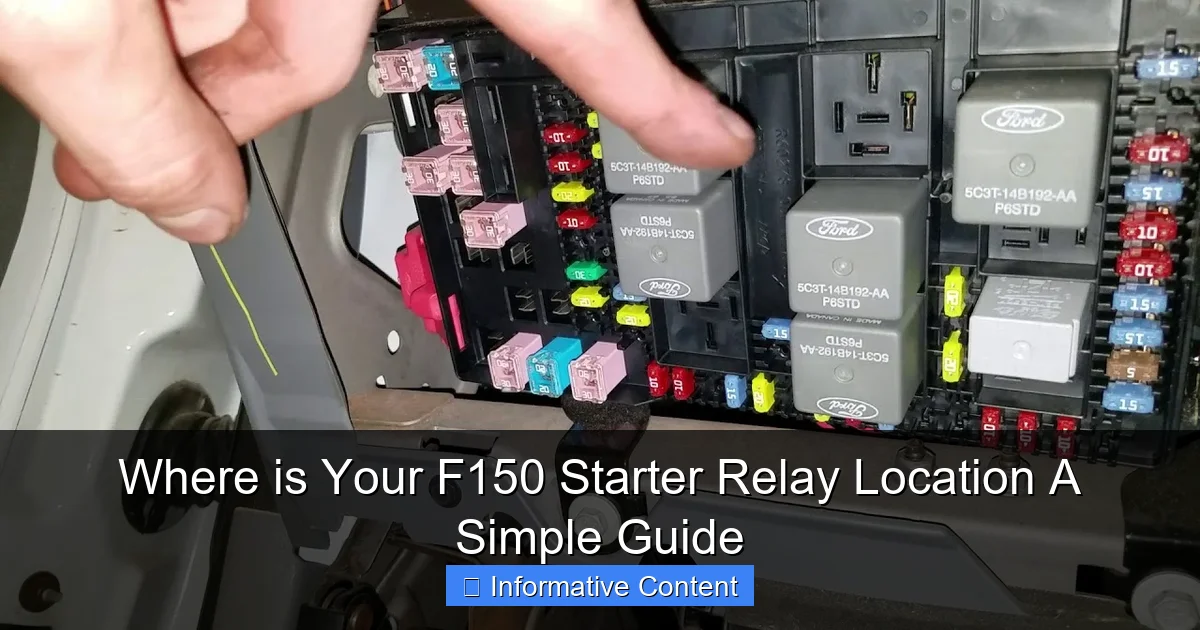
Visual guide about f150 starter relay location
Image source: i.ytimg.com
The Power Distribution Box (Under the Hood)
This is overwhelmingly the most common f150 starter relay location. You’ll find this box under the hood, usually on the driver’s side, near the battery or fender wall. It’s designed to house larger fuses and relays that handle high-current circuits, like the starter motor, fuel pump, and cooling fan. The lid of this box often has a diagram on the underside that labels each fuse and relay, including your specific F150 starter relay location.
The Passenger Compartment Fuse Panel (Inside the Cab)
While less common for the main starter relay, some F150 models or specific circuits might have a related relay here. This fuse panel is usually located inside the cab, often behind a panel on the passenger side kick panel, or sometimes behind the dash or glove box. It typically handles lower-current accessories. Always check the under-hood box first for your f150 starter relay location.
The key takeaway here is to always consult your owner’s manual. It will have the definitive diagram for your specific model year and engine configuration, ensuring you find the precise f150 starter relay location.
Pinpointing Your F150 Starter Relay Location by Generation
While the general rule of “under the hood” holds true, the exact slot or designation for the f150 starter relay location can vary slightly between different generations and model years. Here’s a general guide:
10th Generation F150 (1997-2003/2004 Heritage)
For these classic F150s, the starter relay is typically found in the Power Distribution Box under the hood. Look for a relay labeled “Starter Relay” or “Ignition Relay.” Your owner’s manual will provide a clear diagram, usually showing a specific relay number like R02 or a similar designation within that under-hood box. This is a common f150 starter relay location for this generation.
11th Generation F150 (2004-2008)
Similar to the 10th gen, the f150 starter relay location for the 11th generation is almost always in the under-hood Power Distribution Box. Again, consult your owner’s manual for the exact diagram. The relay might be designated by a number or function on the lid diagram. It’s usually a standard mini-relay.
12th Generation F150 (2009-2014)
In this generation, you’ll still be looking in the Power Distribution Box under the hood for your f150 starter relay location. Ford continued with a similar layout for these components. The owner’s manual for your specific year will be invaluable in pointing out the correct relay amongst the others in the box.
13th Generation F150 (2015-2020)
The pattern continues! For the 13th generation, the f150 starter relay location remains in the under-hood Power Distribution Box. Given the advancements in these trucks, it’s more crucial than ever to refer to your owner’s manual to ensure you’re pulling the correct relay. Sometimes, relays for different functions look identical, so the diagram is key.
14th Generation F150 (2021-Present)
Even the latest F150 models keep the starter relay in the Power Distribution Box under the hood. While the exact position and numbering might evolve, the general f150 starter relay location remains consistent. Always use the diagram found either on the fuse box lid or within your owner’s manual for precise identification.
Practical Tip: If you’ve lost your owner’s manual, don’t fret! Ford typically provides digital versions on their official website. Just enter your F150’s year and model, and you can download the PDF to find your specific f150 starter relay location.
How to Confirm and Test Your F150 Starter Relay
Once you’ve identified the suspected f150 starter relay location, you’ll want to confirm it’s actually the problem before buying a new part. There are a couple of straightforward ways to do this.
Visual Inspection
Carefully pull the relay straight out of its socket. Look for any obvious signs of damage: burnt plastic, corrosion on the terminals, or a rattling sound if you shake it gently (which could indicate internal breakage). Sometimes, the fault is visually apparent.
The “Click Test” / Swap Test
This is the easiest and most common way to test your F150 starter relay without special tools.
- Identify a Similar, Non-Critical Relay: In the same under-hood fuse box, find another relay that is identical in size and shape to your starter relay. Good candidates are relays for the horn, fog lights, or a less critical accessory that won’t leave you stranded if it temporarily doesn’t work.
- Swap Them: Carefully pull out the suspected starter relay. Then, pull out the non-critical, identical relay. Swap their positions. Place the non-critical relay into the starter relay’s spot, and vice versa.
- Test Your F150: Try to start your truck.
- If the truck now starts, congratulations! The original starter relay was faulty.
- If the truck still doesn’t start, and now the horn or fog lights (for example) also don’t work with the swapped relay, it means the relay you swapped into the starter’s spot is good, and your issue likely isn’t the relay.
This method is incredibly effective and gives you a quick answer about your f150 starter relay location and its functionality.
Using a Multimeter (For the More Adventurous)
If you have a multimeter, you can technically test the relay’s continuity and resistance. This involves applying 12V to the coil terminals and checking for continuity across the switch terminals. However, for most DIYers, the swap test is sufficient and much simpler. If you’re comfortable with electrical testing, you can find detailed guides online specific to testing a 4-pin or 5-pin relay, which applies to your f150 starter relay location.
Replacing Your F150 Starter Relay: A Quick Fix
If your testing confirms that your f150 starter relay location is indeed where the problem lies, replacing it is usually a very straightforward process that takes mere minutes.
Safety First
Before you begin any work on your truck’s electrical system, always prioritize safety.
- Disconnect the Battery: Loosen and remove the negative (black) terminal cable from your F150’s battery. This prevents accidental short circuits or electrical shocks.
- Wear Safety Glasses: A good habit for any under-hood work.
The Replacement Process
Once you’ve safely disconnected the battery:
- Remove the Old Relay: Gently but firmly pull the faulty starter relay straight up and out of its socket. It might be a little stiff due to tight connections.
- Match the New Relay: Head to your local auto parts store with the old relay or your truck’s year, make, and model information. Ensure the new relay is an exact match in terms of part number, terminal configuration (4-pin or 5-pin), and amperage rating. Buying the correct part for your f150 starter relay location is crucial.
- Install the New Relay: Line up the pins of the new relay with the corresponding holes in the fuse box socket. Push the new relay firmly down until it’s seated securely. You should feel it click into place.
Post-Replacement Tips
With the new relay in place:
- Reconnect the Battery: Attach the negative battery cable, tightening it securely.
- Test Your Truck: Hop in, turn the key, and enjoy the satisfying sound of your F150 roaring to life!
- Keep the Old Relay: Sometimes a relay can be intermittent. Keep the old one for a bit, just in case the problem was something else, and you need to swap back for diagnostic purposes (though this is rare if the swap test was conclusive).
This simple fix, once you know your f150 starter relay location, can save you time, money, and a lot of frustration. It’s one of those DIY repairs that feels incredibly rewarding.
What to Do If Your F150 Still Won’t Start
While a faulty starter relay is a common culprit, it’s not the only reason your F150 might refuse to crank. If replacing the relay doesn’t solve the problem, don’t despair! Here are a few other areas to check:
Check the Starter Fuse
Right next to the f150 starter relay location in the Power Distribution Box, there’s usually a dedicated fuse for the starter circuit. This fuse protects the system from overcurrents. If it’s blown, no power will reach the relay or starter. A quick visual check (look for a broken filament inside the fuse) or a test with a multimeter can confirm if it’s the issue. Replacing a fuse is even easier than a relay!
Battery Issues
A dead or weak battery is arguably the most common reason for a no-start condition.
- Check Battery Terminals: Ensure they are clean and tight. Corrosion can prevent a good electrical connection.
- Test Battery Voltage: Use a multimeter to check the battery voltage. Anything below 12.4V might indicate a weak battery, and below 12V often means it’s dead.
- Jump Start: Try jump-starting your F150. If it starts with a jump, your battery is likely the problem.
Starter Motor Itself
If the relay and fuse are good, and your battery is fully charged, the starter motor might be failing. This often presents with the same clicking sound, but the click will be coming from the starter motor itself, not the relay. A common temporary fix is to tap the starter motor with a hammer or wrench while someone tries to start the truck (be safe!). If it then starts, the starter motor needs replacement.
Ignition Switch Problems
Less common, but an ignition switch that isn’t sending the correct signal to the relay can also cause a no-start. This is harder to diagnose without specialized tools or professional help.
When to Call a Professional
If you’ve checked these common culprits and your F150 still isn’t starting, it might be time to call a trusted mechanic. Complex electrical issues, problems with the engine’s computer (PCM), or transmission range sensor issues (PATS system) are best left to experts.
Dealing with a non-starting F150 can be frustrating, but knowing the typical f150 starter relay location and how to test it empowers you to troubleshoot a common problem yourself. It’s a simple, inexpensive fix that can save you a significant amount of money in diagnostic fees and parts markup at a repair shop.
So, the next time your F150 greets you with a click instead of a roar, remember this guide. Head straight for that under-hood Power Distribution Box, consult your owner’s manual, and confidently locate and inspect your starter relay. You’ll not only get your trusty truck back on the road but also gain a valuable new skill as an F150 owner. Happy trucking!
Frequently Asked Questions
Where is the F150 starter relay location typically found?
The F150 starter relay is most commonly located in the main power distribution box (PDB) under the hood. This box is usually situated on the passenger side near the firewall or fender well. Refer to your owner’s manual for the exact diagram and fuse/relay identification.
Is the F150 starter relay always located in the main fuse box under the hood?
For most modern F150 models, yes, the starter relay is housed within the power distribution box under the hood. However, some older models might have it in an auxiliary box or even closer to the starter solenoid on the fender. Always check your specific vehicle’s owner’s manual to confirm the precise F150 starter relay location.
What are the common symptoms of a faulty F150 starter relay?
The most common symptom of a bad F150 starter relay is a “no-crank, no-start” condition, where you turn the key but hear only a single click or nothing at all. You might also experience intermittent starting issues or the engine failing to crank despite good battery power.
Does the F150 starter relay location differ significantly between various model years?
While the general principle remains the same, the exact F150 starter relay location can indeed vary slightly between different generations and model years. Newer models almost exclusively place it in the under-hood power distribution box. It’s crucial to consult your truck’s specific owner’s manual or a reliable repair guide for your year and trim to pinpoint its exact spot.
How can I test if my F150 starter relay is working correctly?
You can test the F150 starter relay by carefully swapping it with another known good, identical relay from the same fuse box (e.g., the horn relay, if compatible). If the problem moves or is resolved, the relay is likely faulty. Alternatively, you can use a multimeter to check for continuity and proper coil resistance, or apply 12V to the coil terminals to hear if it clicks.
Can I bypass the F150 starter relay to start my truck in an emergency?
In an emergency, it’s sometimes possible to bypass a faulty F150 starter relay by directly jumping the appropriate terminals in the fuse box or at the starter solenoid. However, this should only be done with extreme caution by someone knowledgeable, as incorrect connections can cause serious damage or injury. It’s a temporary fix to get home, not a long-term solution.