What Is a Hood Release Cable? How It Works and Complete Guide
A vehicle hood must stay securely closed while driving but also open easily when you need access to the engine compartment. The component that allows you to release the hood from inside the cabin is usually the hood release cable. It forms the mechanical connection between the hood release handle and the hood latch assembly, allowing the driver to unlock the primary latch without reaching through the front of the vehicle.
So, what is a hood release cable? It is a flexible mechanical cable that transfers the pulling force from the interior hood release lever to the latch at the front of the vehicle. When you pull the lever, an inner metal cable moves inside a protective outer housing and operates the latch mechanism. The hood then rises slightly, allowing you to release the secondary safety latch and open it fully.
Although a hood release cable is relatively simple, problems with the cable, handle, latch, brackets, or adjustment can make the hood difficult or impossible to open. A cable may stretch, become disconnected, corrode, bind, or eventually break.
This pillar guide explains how does a hood release cable work, its major parts, location, common designs, failure symptoms, causes, diagnosis, maintenance, repair, replacement, and other important information related to the complete hood release system.
What Is a Hood Release Cable?
A hood release cable is a flexible mechanical control cable used to operate a vehicle’s hood latch from inside the passenger compartment.
One end of the cable connects to the hood release lever or handle, usually located underneath the dashboard. The opposite end connects to the hood latch mechanism near the front of the engine compartment.
Pulling the interior lever applies tension to the cable.
That movement operates the latch and releases the hood from its fully locked position.
A hood release cable typically consists of two primary components:
- An internal steel wire or cable
- A protective outer cable housing
The inner cable moves while the outer housing remains relatively stationary.
This arrangement is similar to a Bowden cable, a flexible mechanical cable system commonly used to transmit pulling force around bends.
Because the cable is flexible, manufacturers can route it from the passenger compartment, through the firewall, along the engine bay, and toward the front hood latch.
Quick Answer
The hood release cable connects the interior hood release handle to the hood latch. Pulling the handle moves the inner cable, which releases the primary latch and allows the hood to partially open.
How Does a Hood Release Cable Work?
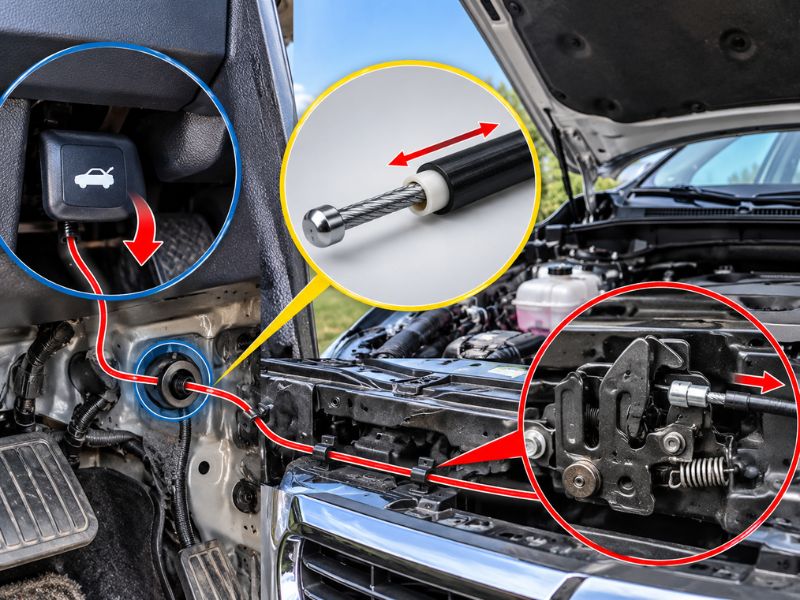
Understanding how does a hood release cable work becomes easier when you look at the system as a series of connected mechanical parts.
The basic operating process is:
- The driver pulls the interior hood release handle.
- The handle pulls the inner hood release cable.
- The cable moves inside its outer housing.
- Cable tension moves a release lever on the hood latch.
- The latch releases the hood striker.
- The hood rises slightly.
- The secondary safety latch keeps the hood from opening completely.
- The driver manually releases the secondary latch.
- The hood can then be raised.
The system is mainly mechanical, although modern vehicles may also use hood latch sensors to electronically monitor whether the hood is open or closed.
Pulling the Hood Release Handle
The process begins with the interior hood release handle.
It is commonly mounted:
- Beneath the driver’s dashboard
- Near the driver’s kick panel
- Beside the lower instrument panel
- Near the driver’s footwell
When you pull this handle, it rotates around a pivot point.
The handle is connected to one end of the hood release cable. Its movement creates tension in the internal cable.
Cable Movement
The cable usually contains a strong steel inner wire surrounded by a flexible protective housing.
When the handle is pulled, the inner cable slides through the outer sheath.
The housing allows the cable to follow curved routing paths while still transmitting force to the latch.
Small brackets and retainers keep the housing secured to the vehicle so that the inner wire can move effectively.
Hood Latch Release
At the front of the vehicle, the cable connects to a lever on the hood latch assembly.
Pulling the cable rotates or moves this release lever.
The latch then releases its grip on the hood striker, which is normally attached to the underside of the hood.
A spring may push the hood upward slightly once the primary latch releases.
Secondary Safety Latch
Releasing the interior cable normally does not completely free the hood.
Most vehicles also have a secondary hood safety latch.
Its purpose is to prevent the hood from flying open if the main latch becomes accidentally released while driving.
After pulling the interior lever, you usually move a second lever underneath the front edge of the hood to fully open it.
Main Parts of a Hood Release System
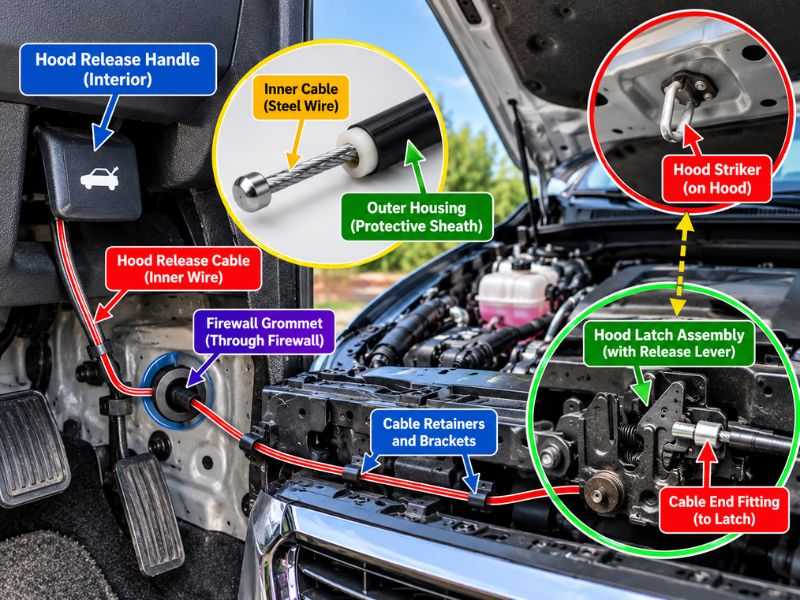
The hood release cable is only one part of the complete system.
Understanding the surrounding components makes diagnosing hood-opening problems much easier.
Hood Release Handle
The hood release handle is the part you pull from inside the vehicle.
It provides mechanical leverage so that a relatively small movement of your hand can produce enough cable tension to operate the latch.
Handles are commonly made from molded plastic attached to a metal or plastic bracket.
Inner Release Cable
The inner cable is the moving portion of the assembly.
It is commonly made from stranded steel wire because the material must be:
- Flexible
- Strong
- Resistant to repeated movement
- Capable of handling tension
Damage to this wire can make the cable feel loose or prevent the hood from opening.
Outer Cable Housing
The cable housing protects and guides the inner wire.
It normally consists of a flexible reinforced sheath with a protective outer covering.
The housing must remain anchored at both ends. If it becomes loose, pulling the handle may move the entire housing rather than pulling the inner cable effectively.
Cable Retainers and Brackets
Small clips, retainers, and brackets secure the hood cable along its route.
They prevent unwanted cable movement and keep it away from:
- Exhaust components
- Moving engine parts
- Sharp edges
- Belts
- Fans
- Excessive heat
A damaged retaining clip can sometimes cause a hood release problem even when the cable itself is intact.
Hood Latch Assembly
The hood latch assembly catches the striker and keeps the hood securely closed.
It contains the mechanism operated by the release cable.
The latch may include:
- Catch mechanism
- Release lever
- Return spring
- Primary latch
- Secondary safety latch
- Hood position switch or sensor
The exact design varies between vehicles.
Hood Striker
The hood striker is usually a metal loop or pin attached to the underside of the hood.
When the hood closes, the striker enters the latch.
The latch captures it and keeps the hood securely locked.
Where Is the Hood Release Cable Located?
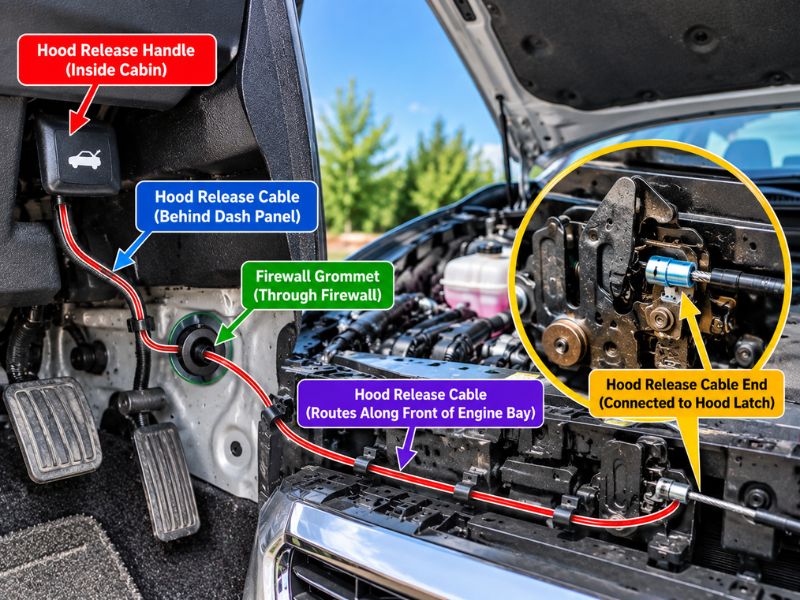
The hood release cable normally extends from the driver’s side of the passenger compartment to the front of the vehicle.
Although routing differs among manufacturers, a typical cable follows this general path:
Hood release handle → dashboard/kick panel → firewall → engine compartment → radiator support area → hood latch
Inside the Vehicle
Start by locating the hood release lever.
It is usually near the driver’s footwell underneath the dashboard.
A cable should connect to the rear of this lever.
On many vehicles, part of the cable is hidden behind:
- Lower dashboard panels
- Kick panels
- Carpet
- Interior trim
Through the Firewall
The cable must travel from the passenger compartment into the engine bay.
It usually passes through the firewall using a rubber grommet or another protected opening.
The grommet helps:
- Protect the cable from sharp metal
- Reduce water intrusion
- Limit vibration
- Seal the passenger compartment
Inside the Engine Compartment
After passing through the firewall, the cable is routed toward the front of the vehicle.
Depending on the design, it may run:
- Along the inner fender
- Beside the engine compartment
- Across the radiator support
- Behind plastic covers
- Through dedicated cable brackets
The front end eventually connects to the hood latch release lever.
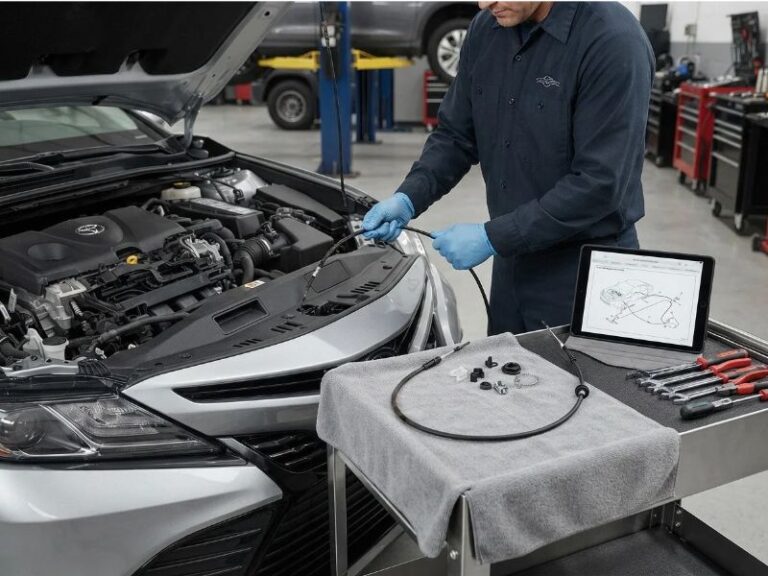
What Does a Hood Release Cable Look Like?
A hood release cable often resembles a thick black wire or narrow flexible hose.
However, what you see externally is usually the cable housing rather than the actual metal cable inside.
Typical visual characteristics include:
- Black flexible outer coating
- Approximately wire-like or small hose-like thickness
- Metal inner cable at the ends
- Plastic or metal fittings
- Mounting clips
- A hooked, barrel, or molded cable end
- Connection to the hood latch
At the dashboard end, the cable may terminate in a small metal fitting connected to the hood release handle.
At the latch end, it typically attaches to a small release arm or lever.
Are All Hood Release Cables the Same?
No.
Although most operate on the same basic principle, hood release cables differ in:
- Length
- End fitting design
- Housing diameter
- Mounting points
- Cable routing
- Latch attachment
- Handle attachment
- Number of cable sections
Some vehicles use a single cable.
Others use a multi-stage hood release cable system.
Single Hood Release Cable
A simple system uses one continuous cable running from the interior handle directly to the hood latch.
Primary and Secondary Cable Sections
Some vehicles divide the system into two or more cable sections.
For example, one cable may connect the interior handle to an intermediate junction, while another connects that junction to the latch.
Dual Hood Latch Systems
Certain vehicles, particularly those with wide hoods, may use two hood latches.
A central cable or junction mechanism can operate both latch points.
These systems require correct adjustment so both sides release and latch properly.
What Happens When You Pull the Hood Release?
When you pull the hood release, you should normally feel increasing resistance followed by a small release sensation.
At approximately the same time, the hood may rise slightly.
Several events occur almost instantly:
The interior lever rotates.
The release cable becomes tensioned.
The latch release arm moves.
The primary latch disengages from the striker.
The hood spring or rubber bump stops may push the hood upward.
The secondary safety latch remains engaged.
This slight movement gives you room to reach under the hood and operate the secondary release.
Why Does a Hood Need Two Latches?
The combination of a primary latch and secondary safety latch is designed to keep the hood secure.
The primary hood latch is released using the interior cable.
The secondary latch normally requires manual operation from outside the vehicle.
If the primary latch accidentally releases while driving, the secondary latch can help prevent the hood from immediately lifting into the windshield.
For this reason, a hood that does not latch securely should not simply be treated as a cable problem.
The complete latch system should be inspected.
Common Symptoms of a Bad Hood Release Cable
Hood release cables can develop several recognizable symptoms as they wear or become damaged.
Hood Release Handle Feels Loose
An unusually loose handle can indicate:
- Broken cable
- Disconnected cable end
- Broken release handle
- Damaged mounting bracket
- Detached outer housing
If there is almost no resistance when pulling the lever, the cable may no longer be connected to the latch.
Hood Release Handle Is Hard to Pull
A hood release lever that requires excessive force may indicate increased resistance somewhere in the system.
Possible causes include:
- Corroded cable
- Binding inner cable
- Dirty hood latch
- Rusted latch
- Incorrect cable routing
- Damaged cable housing
- Misaligned hood striker
Continuing to pull excessively hard can damage the handle or eventually break the cable.
Hood Does Not Pop Up
You may hear or feel the latch releasing but notice that the hood does not rise.
Possible causes include:
- Weak hood spring
- Compressed hood bump stops
- Latch contamination
- Hood alignment problem
- Striker adjustment
- Cable not pulling the latch far enough
The cable is not always the actual cause.
Hood Opens Only After Pulling Several Times
Repeated pulling may indicate that the cable is not moving the latch through its full required range.
Possible causes include:
- Cable stretch
- Loose housing
- Improper adjustment
- Worn latch
- Handle wear
- Internal cable damage
Hood Release Works Intermittently
Intermittent operation often indicates a system that is beginning to bind or has excessive play.
Ignoring the problem can eventually leave the hood stuck closed.
Why Do Hood Release Cables Fail?
A hood release cable can last for many years, but it is still a mechanical component subject to wear.
Corrosion
Moisture can enter damaged portions of the cable housing.
The inner steel cable may begin to rust.
Corrosion increases friction and can eventually weaken the cable.
Cable Fraying
Individual strands of the metal cable can begin to break.
A frayed cable may continue operating temporarily but usually becomes weaker and less smooth.
Cable Stretch
Repeated operation can produce additional free play in some systems.
A stretched or poorly adjusted cable may not move the latch far enough.
Damaged Outer Housing
If the housing cracks, bends sharply, or becomes crushed, the inner cable may bind.
Damage may occur after:
- Collision repairs
- Engine work
- Body repairs
- Incorrect cable installation
Broken Hood Release Handle
Sometimes the cable is fine but the plastic handle breaks around the cable attachment point.
A broken handle can create symptoms almost identical to a failed cable.
Cable Becomes Disconnected
A cable end can occasionally detach from either the interior handle or latch.
Retaining clips can also break or come loose.
Hood Latch Corrosion or Contamination
A stiff hood latch makes the cable work harder.
Eventually, this additional resistance can damage the cable or release handle.
Therefore, replacing the cable without addressing a binding latch may result in another failure.
How to Tell if the Hood Release Cable Is Broken
A few observations can help narrow down the problem.
First, pull the interior hood release handle normally.
Pay attention to how it feels.
A functioning cable usually provides noticeable resistance.
If the lever suddenly moves freely with almost no resistance, inspect the handle and visible cable connection.
If the handle feels extremely stiff, avoid repeatedly forcing it.
Next, determine whether you can hear any movement near the front latch while someone carefully operates the interior lever.
Movement at the latch suggests that at least some cable force is reaching it.
The complete system should then be checked for:
- Correct cable attachment
- Broken clips
- Housing movement
- Cable damage
- Latch movement
- Rust
- Dirt
- Striker alignment
- Release lever travel
Hood Release Cable vs. Hood Latch: Which One Is Bad?
Because the cable and latch work together, their symptoms can overlap.
A cable problem is more likely when:
- Release handle suddenly becomes loose
- Cable is visibly damaged
- Cable housing moves excessively
- Cable is disconnected
- Latch does not move when the handle is pulled
A hood latch problem is more likely when:
- Cable appears to move normally
- Latch is visibly rusty
- Latch movement is stiff
- Hood has trouble catching when closed
- Hood releases only after pressing down on it
- Latch does not return properly
A proper diagnosis should consider both components.
Can a Hood Release Cable Stretch?
Yes, some hood release systems can develop excessive cable slack over time.
The steel cable itself may experience limited elongation, while wear at the handle, fittings, brackets, or latch can also create the effect of a stretched cable.
The result is the same: pulling the lever does not produce enough movement at the latch.
Some systems provide an adjustment method.
Others require replacement of worn components.
Can a Hood Release Cable Be Adjusted?
It depends on the vehicle.
Certain hood release systems allow limited adjustment through:
- Cable mounting position
- Adjustable fittings
- Latch position
- Striker position
Many modern cable assemblies are effectively fixed-length components and are not intended to be manually shortened.
Before attempting adjustment, it is important to determine whether the problem is actually cable slack or a misaligned hood latch.
Incorrect latch or striker adjustment can create problems with hood closing and safety.
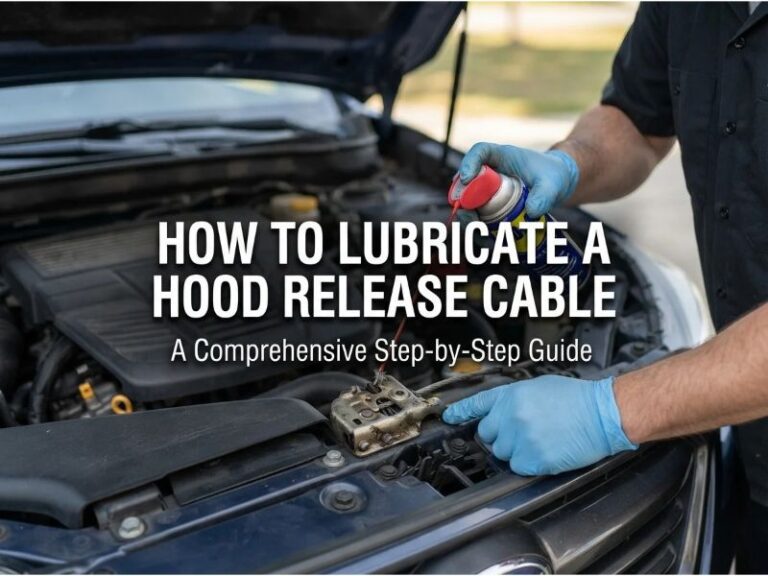
Can You Lubricate a Hood Release Cable?
Some cable and latch problems can improve with appropriate maintenance, but lubrication requirements vary by design.
The most useful maintenance area is often the hood latch mechanism, because dirt and corrosion there can dramatically increase cable load.
The latch should remain:
- Clean
- Free-moving
- Properly aligned
- Protected from excessive corrosion
For the cable itself, follow the vehicle manufacturer’s service recommendations.
Many modern cables have liners or sealed housings that are not designed to be filled with general-purpose lubricant.
Using an unsuitable product can attract dirt or damage some materials.
How Long Does a Hood Release Cable Last?
There is no universal replacement interval for a hood release cable.
Many last for a large portion of the vehicle’s service life.
Longevity depends on:
- Climate
- Moisture exposure
- Road salt
- Cable routing
- Hood-opening frequency
- Latch condition
- Previous repairs
- Component quality
A cable exposed to corrosion or excessive latch resistance may fail considerably sooner.
The best strategy is to respond to changes in operation before complete failure occurs.
What Should a Normal Hood Release Feel Like?
A healthy hood release should usually feel:
- Smooth
- Firm
- Consistent
- Relatively easy to pull
You may feel resistance as the latch spring loads, followed by a noticeable release.
The handle should generally return to its resting position.
A sudden change in feel deserves attention.
Examples include:
- Much looser than before
- Much harder than before
- Grinding sensation
- Jerky movement
- Failure to return
- Multiple pulls required
These changes can provide early warning of cable or latch problems.
What Happens if the Hood Release Cable Breaks?
If the cable breaks while the hood is closed, the normal interior release lever will no longer operate the latch.
Accessing the latch can become difficult because vehicle manufacturers intentionally place the hood release mechanism in protected areas.
The correct method for opening a hood with a failed release cable varies significantly by vehicle design.
Whenever possible, consult the manufacturer’s service information or have a qualified technician open it without damaging the hood, grille, latch, wiring, or surrounding bodywork.
Avoid aggressively prying the hood upward. The primary and secondary latches are designed to resist that type of force, and forcing them can damage the hood.
Can You Drive With a Broken Hood Release Cable?
A broken release cable does not automatically mean the hood is unlocked.
If the hood latch is fully engaged, the cable normally only matters when you need to open the hood.
However, delaying repair can create practical problems because you may not be able to access the engine compartment when needed.
That means you could have difficulty checking or servicing components such as:
- Engine oil
- Coolant reservoir
- Battery
- Brake fluid
- Windshield washer fluid
- Fuse box
- Air filter
More importantly, if there is any doubt about whether the hood itself is securely latched, the latch should be inspected before driving.
Hood Release Cable Repair vs. Replacement
Whether the system can be repaired depends on what has failed.
When a Minor Repair May Be Enough
Replacement of the complete cable may not be necessary if the problem is caused by:
- Loose retaining clip
- Minor latch contamination
- Handle attachment issue
- Latch adjustment
- Striker alignment
Correcting the related component may restore normal operation.
When Cable Replacement Is Usually Better
Replacement is generally more appropriate when the cable is:
- Broken
- Severely corroded
- Frayed
- Kinked
- Crushed
- Damaged internally
- Separated from a non-serviceable end fitting
A damaged safety-related mechanical cable generally should not be temporarily patched and expected to perform like a properly installed replacement.
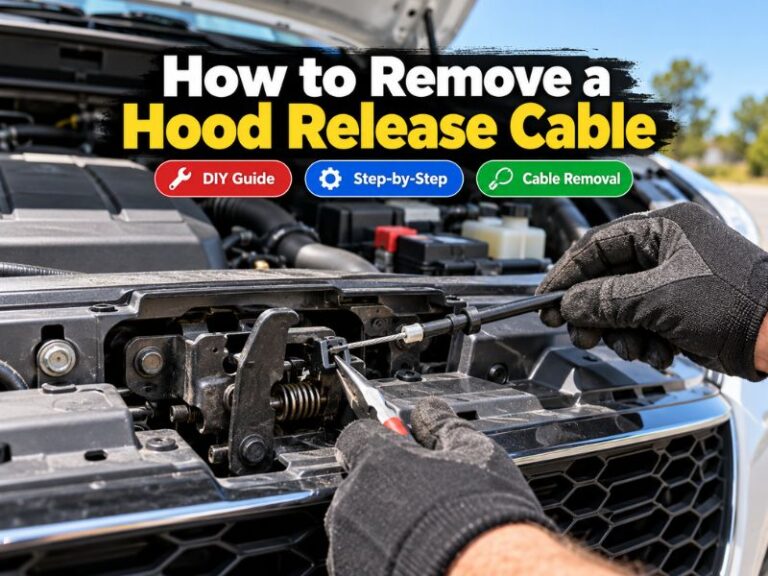
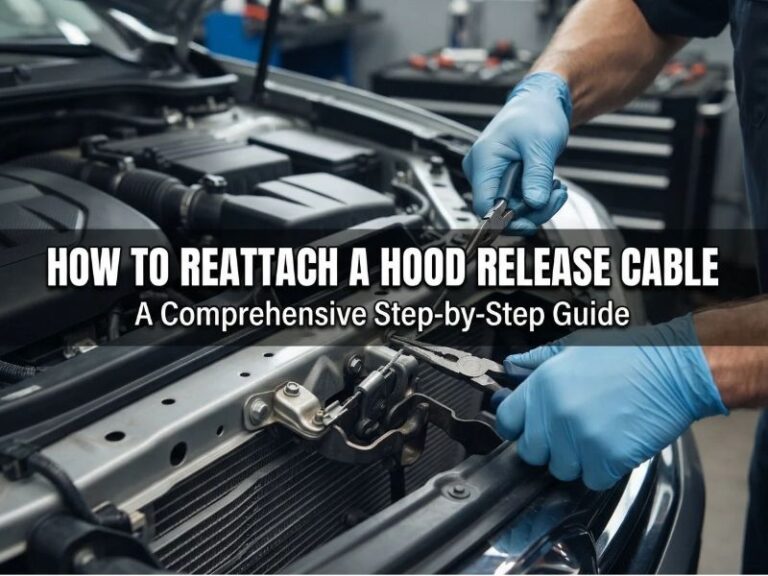
What Is Involved in Hood Release Cable Replacement?
The exact procedure varies by vehicle, but replacement generally involves working at both ends of the cable.
A technician typically needs to:
- Gain access to the hood latch.
- Disconnect the cable from the latch.
- Remove cable retaining clips or brackets.
- Access the interior hood release handle.
- Disconnect the cable from the handle.
- Remove trim panels when necessary.
- Route the old cable out of the vehicle.
- Route the replacement cable along the correct path.
- Secure all brackets and clips.
- Connect both cable ends.
- Confirm proper latch operation.
- Verify the hood locks securely before driving.
Proper cable routing is particularly important.
Sharp bends, excessive heat, moving components, or incorrect clips can shorten cable life or prevent smooth operation.
Should the Hood Latch Be Checked When Replacing the Cable?
Yes.
A cable may fail because the hood latch requires excessive force to operate.
Installing a new cable without correcting a seized or dirty latch can place the same excessive load on the replacement.
The complete system should be inspected for:
- Rust
- Dirt
- Broken springs
- Binding movement
- Bent components
- Incorrect alignment
- Damaged striker
- Excessive friction
This is especially important when the original cable failed gradually rather than from obvious accidental damage.
How Can You Prevent Hood Release Cable Problems?
Hood release systems generally require little maintenance, but a few habits can improve reliability.
Keep the Hood Latch Clean
Inspect the latch periodically for dirt and excessive corrosion.
A clean, freely moving latch requires less cable force.
Pay Attention to Increased Resistance
Do not ignore a hood release handle that gradually becomes harder to pull.
Higher resistance may be an early sign of:
- Cable binding
- Latch corrosion
- Misalignment
Correcting the problem early may prevent complete cable failure.
Avoid Slamming or Forcing the Hood
Use the vehicle manufacturer’s recommended method for closing the hood.
Repeatedly forcing a misaligned hood can damage:
- Latch
- Striker
- Cable
- Hood alignment
Check Cable Routing After Repairs
If front-end, engine-bay, or body work has recently been performed, make sure the cable has not been:
- Pinched
- Re-routed incorrectly
- Left unsecured
- Placed against a hot component
Hood Release Cable and Hood Latch Sensor: Are They the Same?
No.
The hood release cable is a mechanical component used to open the hood.
The hood latch sensor is an electrical component used to detect whether the hood is open or closed.
They can both be connected to the hood latch assembly, but they serve very different purposes.
The release cable physically moves the latch.
The sensor sends hood-status information to electronic systems such as the:
- Body Control Module (BCM)
- Instrument cluster
- Vehicle alarm
- Remote-start system
A vehicle can therefore have a perfectly functional release cable but a faulty hood latch sensor, or vice versa.
Hood Release Cable vs. Hood Release Handle
The terms are sometimes used interchangeably in casual conversation, but they are separate parts.
The hood release handle is the lever you physically pull.
The hood release cable transfers that pulling motion to the latch.
A broken handle can prevent a perfectly good cable from being operated.
For that reason, a loose hood release lever should not automatically lead to cable replacement without first examining the handle and its cable attachment.
Hood Release Cable vs. Hood Latch
The hood latch locks the hood.
The hood release cable unlocks the primary latch when the driver pulls the interior handle.
A simplified explanation is:
Handle → Cable → Latch → Striker
All four must work together for normal hood operation.
Frequently Asked Questions
What is a hood release cable used for?
A hood release cable transfers mechanical force from the interior hood release handle to the hood latch, allowing the driver to release the primary latch and open the hood.
How does a hood release cable work?
Pulling the interior handle moves a steel inner cable inside a flexible outer housing. The cable pulls a release lever on the hood latch, which releases the hood striker from the primary latch.
Where is the hood release cable located?
It normally starts at the hood release lever near the driver’s footwell, passes through the firewall and engine compartment, and ends at the hood latch near the front of the vehicle.
What does a hood release cable look like?
It usually looks like a black flexible wire or small hose. Inside the protective outer housing is a steel cable that slides when the hood release handle is pulled.
Why is my hood release lever loose?
A loose lever may indicate a broken cable, disconnected cable end, broken handle, damaged bracket, or excessive cable slack.
Why is my hood release hard to pull?
Common causes include a binding cable, rusted hood latch, damaged cable housing, incorrect routing, latch contamination, or hood alignment problems.
Can a hood release cable break?
Yes. The steel cable can corrode, fray, stretch, disconnect, or eventually break from age, wear, or excessive resistance from the latch.
Can a hood release cable be repaired?
Minor problems involving clips, adjustment, or attachment points may sometimes be repairable. A cable that is broken, badly frayed, kinked, or corroded is generally replaced.
Does the hood release cable control the secondary latch?
Usually, no. The interior cable releases the primary hood latch. The secondary safety latch is typically released manually after the hood pops up.
Why does my hood not pop up when I pull the release?
Possible causes include cable slack, latch binding, hood misalignment, a weak hood spring, damaged bump stops, or an improperly adjusted striker.
Is a hood release cable electronic?
Most conventional hood release cables are entirely mechanical.
Some newer vehicles may use more complex electronic release systems, but the traditional cable operates through physical pulling force.
Is the hood release cable connected to the hood latch sensor?
They may both be part of or connected near the same latch assembly, but they perform different jobs. The cable mechanically releases the latch, while the sensor electronically monitors hood position.
How do I know if the cable or latch is bad?
A very loose release handle often points toward a cable or handle problem. A stiff handle combined with a latch that is difficult to move may indicate a binding latch or cable. Inspecting both parts provides a more accurate diagnosis.
Does a broken hood release cable mean the hood can open while driving?
Not normally. The cable is designed to release the latch when pulled. If the cable breaks while the latch is fully locked, the latch generally remains engaged. However, any hood that does not securely latch should be inspected before driving.
Should I replace the hood latch when replacing the cable?
Not automatically. However, the latch should be inspected and serviced if it is rusty, damaged, misaligned, or difficult to operate. A binding latch can place excessive strain on a new cable.
Conclusion
Understanding what is a hood release cable is important because this relatively simple component provides the mechanical connection that allows you to access the engine compartment whenever maintenance, inspection, or repairs are required.
A typical hood release system begins with the interior hood release handle. Pulling the handle places tension on a flexible steel cable. That cable runs through a protective housing, passes from the passenger compartment through the firewall, travels toward the front of the vehicle, and connects to the hood latch assembly. When the cable moves, it operates the latch release lever and frees the hood striker from the primary latch. The secondary safety latch then keeps the hood partially secured until it is manually released.
Knowing how does a hood release cable work also makes troubleshooting easier. A loose handle may indicate a broken or disconnected cable, while a very stiff handle may point to corrosion, cable binding, or a seized hood latch. Problems can also come from the release handle, mounting clips, cable housing, striker alignment, latch springs, or other components within the hood release system.
Because the hood cable and latch depend on each other, diagnosis should involve the entire system rather than replacing one component based only on a single symptom. Keeping the hood latch clean, properly aligned, and free-moving, while addressing unusual cable resistance early, can reduce strain and help the hood release system continue operating reliably.