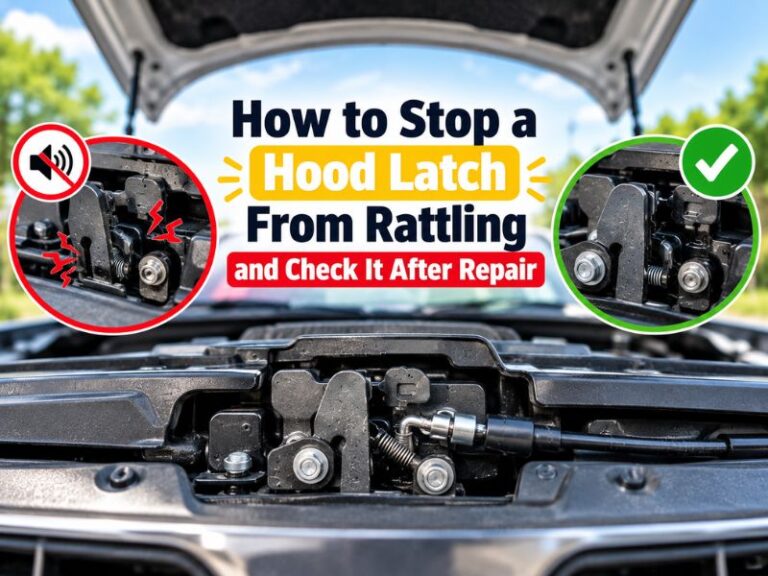
What Is a Hood Latch? Function, Location, Look, and How It Works
A car’s hood needs to stay firmly secured while driving but also open easily whenever you need access to the engine compartment. The small mechanical assembly responsible for doing both jobs is the hood latch. Although it may not get much attention during normal vehicle maintenance, it plays an important role in hood operation and vehicle safety.
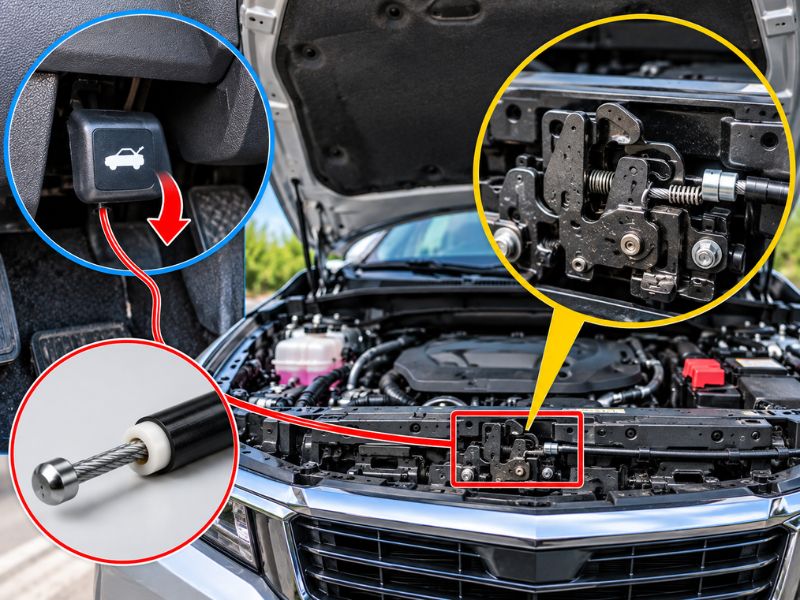
So, what is a hood latch? A hood latch is the mechanical locking mechanism that captures the hood striker when the hood closes and keeps the hood securely attached to the vehicle. When you pull the interior hood release handle, a hood release cable operates the latch, allowing the hood to rise slightly. A separate secondary safety latch normally prevents the hood from opening completely until you manually release it.
Modern hood latch assemblies can also contain an electrical hood latch sensor that tells the vehicle whether the hood is open or closed. That information may be used by the instrument cluster, security system, alarm, or remote-start system.
This pillar guide explains what does a hood latch do, how does a hood latch work, what does a hood latch look like, and where is the hood latch located. It also covers its major parts, different designs, common problems, failure symptoms, maintenance, adjustment, diagnosis, and replacement.
What Is a Hood Latch and What Does It Do?
A hood latch is a mechanical catch or locking assembly installed at the front of a car, truck, SUV, or other vehicle. Its primary job is to hold the hood securely in the closed position.
The hood itself is normally attached to the body by hood hinges at one end. At the opposite end is a metal hood striker, which enters the latch when the hood is closed.
Once the striker enters the latch, internal components rotate or move into position and lock around it.
The hood then remains secured until the latch is intentionally released.
Depending on the manufacturer, the same component may be called a:
- Hood latch
- Hood lock
- Hood lock assembly
- Hood catch
- Bonnet latch
- Bonnet lock
- Hood locking mechanism
Although terminology varies, these names generally describe the mechanism responsible for securing the hood.
Is a Hood Latch the Same as a Hood Lock?
In most everyday automotive applications, hood latch and hood lock refer to the same or closely related component.
The word “latch” emphasizes the mechanical catching mechanism, while “lock” emphasizes its ability to keep the hood secured.
Parts catalogs and service manuals may use either term.
A standard factory hood latch should not be confused with an aftermarket keyed hood lock or hood pin system designed primarily for additional security or motorsport applications.
What Does a Hood Latch Do?
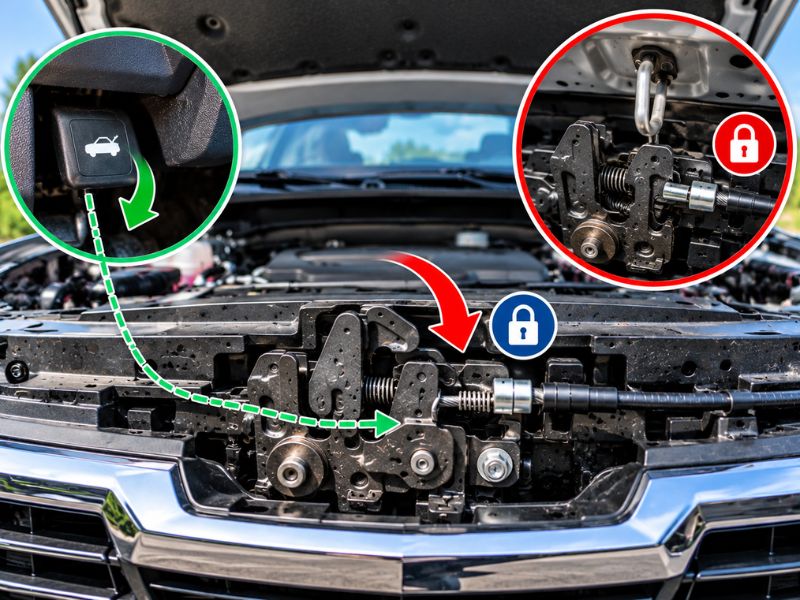
The most important function of a hood latch is simple: it prevents the hood from opening while the vehicle is moving.
However, the complete latch system performs several related functions.
A hood latch helps:
- Keep the hood securely closed
- Capture and hold the hood striker
- Maintain proper hood positioning
- Allow controlled hood opening
- Work with the hood release cable
- Support the secondary safety latch
- Help prevent unintended hood opening
- Provide hood-position information when a sensor is integrated
- Support alarm and remote-start functions on equipped vehicles
The latch must be strong enough to hold the hood against vibration, bumps, wind pressure, and aerodynamic forces encountered during driving.
Why Is the Hood Latch Important for Safety?
The hood forms a large surface at the front of a vehicle. If it were to open unexpectedly at speed, airflow could force it upward.
An open hood could potentially:
- Block the driver’s forward view
- Strike the windshield
- Damage the hinges
- Damage body panels
- Create a road hazard
For this reason, most vehicles use both a primary hood latch and a secondary safety latch.
The two-stage system provides additional protection if the primary latch is unintentionally released.
How Does a Hood Latch Work?
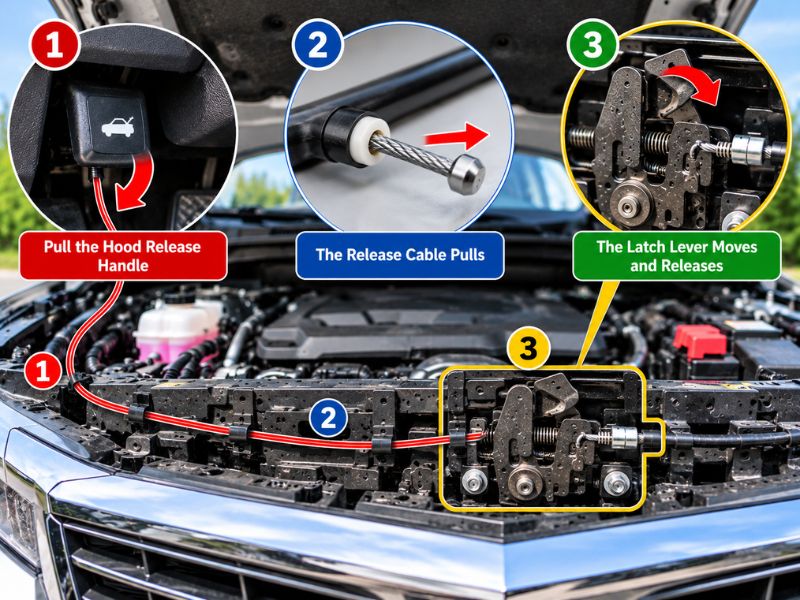
Understanding how does a hood latch work starts with the relationship between the latch and hood striker.
The basic process is:
- The hood is lowered.
- The hood striker enters the latch opening.
- The striker pushes against an internal rotating catch.
- The catch rotates around the striker.
- A locking pawl holds the catch in place.
- The striker becomes trapped inside the latch.
- The hood remains securely closed.
- Pulling the interior hood release moves the release cable.
- The cable disengages the primary latch.
- The hood rises slightly while the secondary latch remains engaged.
Although individual designs vary, this general principle is used on many vehicles.
How the Hood Latch Locks
When you lower the hood, the metal hood striker approaches the latch.
The striker may be shaped like a loop, pin, U-shaped bracket, or reinforced metal hook.
As it enters the latch, it contacts a movable internal component often called a:
- Catch
- Claw
- Rotor
- Pawl
- Latching plate
The striker forces this component to rotate.
Once it reaches the proper position, another spring-loaded part prevents the catch from rotating backward.
The hood is now locked.
What Keeps the Latch Locked?
The latch uses mechanical geometry and spring tension to hold its internal parts in the locked position.
When properly engaged, simply pulling upward on the hood should not release the primary latch.
The release mechanism must be deliberately operated before the latch can rotate back into its open position.
This is why a properly functioning hood remains securely closed over bumps and during normal vehicle movement.
How the Hood Latch Releases
To open the hood, the driver usually pulls an interior hood release handle.
That handle is connected to the latch through a hood release cable.
Pulling the handle causes the inner cable to move inside its protective housing.
At the front of the vehicle, the cable pulls a release lever on the hood latch.
This movement releases the locking pawl and allows the main catch to rotate away from the striker.
The hood then rises slightly.
What Is the Secondary Hood Latch?
Releasing the primary hood latch normally does not allow the hood to open completely.
A secondary safety latch remains engaged.
You usually need to place your fingers underneath the front edge of the hood and move a lever before lifting the hood fully.
This additional mechanism is an important safety feature.
How the Secondary Safety Latch Works
The secondary latch usually catches the hood or striker independently of the main release mechanism.
After the primary latch releases, the hood may move upward only a small distance.
The safety catch prevents additional movement.
Moving the secondary release lever manually clears the catch and allows the hood to open.
Why Does the Hood Pop Up but Not Open?
This is normal operation.
Pulling the interior hood release is designed to release only the primary locking mechanism.
The slight gap that appears provides access to the secondary release.
If the hood immediately opened completely after pulling the interior lever, the secondary safety mechanism might not be functioning correctly.
What Does a Hood Latch Look Like?
If you are wondering what does a hood latch look like, it usually appears as a compact metal locking mechanism attached to the front structure of the vehicle.
Most hood latches are made primarily from stamped or formed steel.
A typical latch may include:
- Metal mounting plate
- Large opening for the hood striker
- Rotating catch or claw
- Release lever
- Springs
- Cable attachment point
- Secondary safety catch
- Mounting bolts
- Electrical connector on sensor-equipped models
The exact shape differs significantly among manufacturers and vehicle models.
What Does an Integrated Hood Latch Sensor Look Like?
Modern vehicles may have a hood latch sensor built directly into the latch assembly.
In that case, you may notice:
- Black plastic housing
- Electrical connector
- Two or more wires
- Wiring harness attached to the latch
The actual sensor may be hidden inside the latch.
Therefore, the presence of an electrical connector is often the easiest visual clue that the hood latch includes electronic hood-position monitoring.
Where Is the Hood Latch Located?
If you are asking where is the hood latch located, the most common position is near the front center of the engine compartment.
It is usually mounted to the:
- Upper radiator support
- Front crossmember
- Upper tie bar
- Structural panel behind the grille
The latch is positioned directly below the hood striker so the two components meet when the hood closes.
How to Find the Hood Latch
Open the hood and look underneath it.
Find the metal hood striker attached near the front edge.
Then look directly below where that striker meets the vehicle body.
The metal assembly that captures the striker is the hood latch.
You may need to look underneath a plastic radiator cover or trim panel to see the entire mechanism.
Are Hood Latches Always in the Center?
No.
A single center-mounted latch is common, but not universal.
Some vehicles use:
- One central latch
- An offset latch
- Two separate side latches
- Multiple interconnected latch mechanisms
Vehicles with particularly wide hoods may use dual hood latches to secure both sides more evenly.
Main Parts of a Hood Latch System
The complete hood locking system involves several components beyond the latch itself.
Hood Striker
The hood striker is the metal loop, hook, or pin attached to the underside of the hood.
It enters the latch when the hood closes.
Correct striker alignment is critical for smooth operation.
Primary Hood Latch
The primary latch is the main mechanism that captures and locks the striker.
It carries most of the responsibility for keeping the hood closed during normal driving.
Secondary Safety Latch
The secondary latch provides backup protection and prevents the hood from opening completely after the primary latch releases.
Hood Release Cable
The hood release cable transfers movement from the interior release handle to the latch.
It typically consists of an internal steel cable surrounded by a protective housing.
Hood Release Handle
The release handle is located inside the passenger compartment, usually near the driver’s footwell.
Pulling it operates the cable.
Return Springs
Small springs move the latch components back into their correct positions after the hood is opened or released.
Hood Latch Sensor
Some vehicles include a hood position sensor, microswitch, or hood-ajar switch inside the latch.
It provides an electrical signal indicating whether the hood is open or closed.
Hood Bump Stops
Rubber bump stops help support and position the hood when closed.
They may also provide slight upward pressure that helps the hood pop up after the primary latch releases.
Hood Latch vs. Hood Release Cable
The hood latch and release cable work together, but they are different parts.
The hood latch physically secures the hood.
The hood release cable provides the mechanical connection used to release it.
The operating sequence can be simplified as:
Release Handle → Release Cable → Hood Latch → Hood Striker
If the cable breaks, the latch may remain locked even though it is functioning normally.
If the latch seizes, a perfectly good release cable may be unable to open it.
That is why both components should be considered when diagnosing a hood that will not open.
Hood Latch vs. Hood Latch Sensor
The hood latch performs a mechanical job.
The hood latch sensor performs an electrical monitoring job.
The latch physically holds the hood closed.
The sensor reports hood status to electronic systems.
Depending on the vehicle, hood-position information may be used by the:
- Body Control Module (BCM)
- Instrument cluster
- Anti-theft system
- Vehicle alarm
- Remote-start system
A sensor failure does not necessarily mean that the mechanical latch is defective.
Likewise, the latch can be mechanically damaged while the sensor remains functional.
Hood Latch vs. Hood Hinges
The hood hinges and hood latch secure opposite ends of the hood.
Hinges allow the hood to pivot upward and downward.
The latch locks the front portion of the hood in place.
Problems with hinges can sometimes create latch symptoms.
For example, a bent hinge may shift the hood enough that the striker no longer aligns correctly with the latch.
This is especially possible after front-end or hood damage.
What Are the Signs of a Bad Hood Latch?
A failing hood latch can produce several noticeable symptoms.
Hood Will Not Close
If the hood repeatedly bounces back instead of locking, possible causes include:
- Latch stuck in closed position
- Misaligned striker
- Corrosion
- Broken latch spring
- Bent latch
- Hood alignment problem
Hood Will Not Stay Closed
A hood that appears to close but will not remain securely latched may have damaged locking components.
Possible causes include:
- Worn catch
- Broken pawl
- Weak spring
- Incorrect latch alignment
- Damaged striker
- Collision damage
This condition should be addressed before normal driving.
Hood Will Not Open
A hood that remains closed after pulling the release may be caused by:
- Stuck latch
- Rust or corrosion
- Broken release cable
- Cable stretch
- Binding release mechanism
- Striker pressure
- Hood misalignment
Hood Release Is Hard to Pull
A stiff release handle can indicate excessive resistance at either the cable or latch.
Common causes include:
- Corroded latch
- Dirty mechanism
- Binding cable
- Misaligned striker
- Damaged cable housing
Repeatedly forcing the handle can eventually break the cable or handle.
Hood Needs Several Pulls to Open
If the hood opens only after repeated attempts, there may be excessive cable slack, latch wear, poor adjustment, or increasing internal friction.
Hood Opens Only When Someone Pushes Down
This often indicates excessive tension between the striker and latch.
Pressing down temporarily removes some of that tension, allowing the latch to release.
Potential causes include alignment or adjustment problems.
Why Do Hood Latches Fail?
A hood latch operates at the front of the vehicle, where it may be exposed to dirt, moisture, temperature changes, vibration, and road contamination.
Dirt and Debris
Dust, sand, leaves, dried grease, and road debris can accumulate around moving latch components.
Contamination may make the mechanism increasingly difficult to operate.
Rust and Corrosion
Water and road salt can corrode the steel latch.
Rust increases friction and can eventually affect springs, pivots, or locking surfaces.
Worn Internal Parts
Every opening and closing cycle creates movement between latch components.
Over a long period, catches, pivots, or other surfaces can wear.
Broken or Weak Springs
The latch relies on springs to control several movements.
A damaged spring may prevent the latch from locking, releasing, or returning properly.
Hood or Striker Misalignment
The latch itself may be healthy, but incorrect striker alignment can prevent normal operation.
Possible causes include:
- Collision damage
- Hood adjustment
- Bent hood
- Loose striker bolts
- Body repairs
- Worn hood hinges
Release Cable Problems
A stretched, corroded, disconnected, or damaged release cable may prevent the latch from receiving enough movement to release.
Can a Hood Latch Get Stuck?
Yes.
A hood latch may become stuck in either the open or closed position.
Latch Stuck Closed
If the latch stays locked after the release is pulled, possible causes include corrosion, cable problems, excessive striker pressure, or damaged internal components.
Latch Stuck Open
Sometimes the latch can move into its locked position while the hood itself is open.
When this happens, the striker cannot enter because the latch opening is already blocked.
The latch must be returned to the correct open position using the appropriate procedure before closing the hood.
Do not repeatedly slam the striker against a closed latch.
How Do You Know if the Hood Latch or Release Cable Is Bad?
The feel of the interior release handle can provide useful clues.
A cable problem may be more likely if:
- Handle suddenly feels completely loose
- There is almost no resistance
- Cable is visibly disconnected
- Cable housing moves excessively
- Latch does not react when the handle moves
A latch problem may be more likely if:
- Cable clearly moves the release lever
- Latch is visibly rusty
- Mechanism moves slowly
- Hood will not stay closed
- Latch will not return
- Striker engagement feels rough
These are diagnostic clues rather than absolute rules because both components can fail simultaneously.
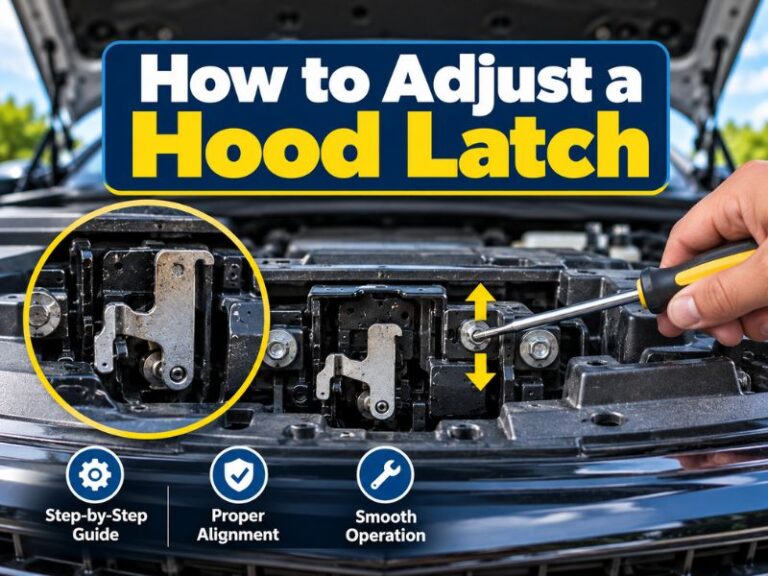
Can a Hood Latch Be Adjusted?
Many vehicles allow limited adjustment of the hood locking system.
Depending on the design, adjustment may involve the:
- Hood latch position
- Hood striker position
- Hood bump stops
- Hood hinges
Correct adjustment determines how deeply the striker enters the latch and how the hood sits relative to surrounding body panels.
A latch positioned too low can create excessive closing force.
A latch positioned incorrectly may prevent complete engagement.
Because the hood is a safety-related component, adjustment should preserve full primary and secondary latch engagement.
Should a Hood Latch Be Lubricated?
A hood latch contains several moving metal parts and can benefit from appropriate maintenance.
Keeping the mechanism clean and moving freely can reduce strain on both the latch and hood release cable.
Maintenance generally focuses on:
- Removing dirt and debris
- Checking for corrosion
- Keeping pivots moving freely
- Inspecting springs
- Checking release action
- Confirming proper striker alignment
Lubricant recommendations differ by vehicle manufacturer and latch design.
Using excessive lubricant can attract dirt, so more is not always better.
How Long Does a Hood Latch Last?
There is no standard mileage or replacement interval for a hood latch.
Many original hood latches continue working for a large portion of a vehicle’s service life.
Longevity depends on factors including:
- Climate
- Road salt exposure
- Moisture
- Maintenance
- Collision history
- Hood-opening frequency
- Latch alignment
- Component quality
Changes in operation are usually more useful than vehicle mileage for determining when the latch needs attention.
Can You Drive With a Bad Hood Latch?
The answer depends on the type of problem.
If the mechanical latch does not securely hold the hood closed, normal driving can be unsafe.
Before driving, the hood should:
- Fully engage the primary latch
- Remain locked when gently checked
- Engage the secondary safety latch
- Sit in its proper position
If the hood can lift despite appearing closed, the latch system needs attention.
An electronic hood-open warning caused by a faulty hood latch sensor is different from a mechanical failure. However, the physical latch should still be checked to verify that the hood is actually secured.
Can a Hood Latch Be Repaired?
Some hood latch problems can be corrected without replacing the entire assembly.
Possible serviceable issues include:
- Dirt accumulation
- Minor corrosion
- Improper adjustment
- Loose mounting bolts
- Striker misalignment
- Cable attachment problems
Replacement may be more appropriate when the latch has:
- Broken springs
- Severely worn catches
- Structural damage
- Severe corrosion
- Bent components
- Damaged locking surfaces
A damaged locking mechanism should not depend on improvised repairs if its ability to keep the hood closed is uncertain.
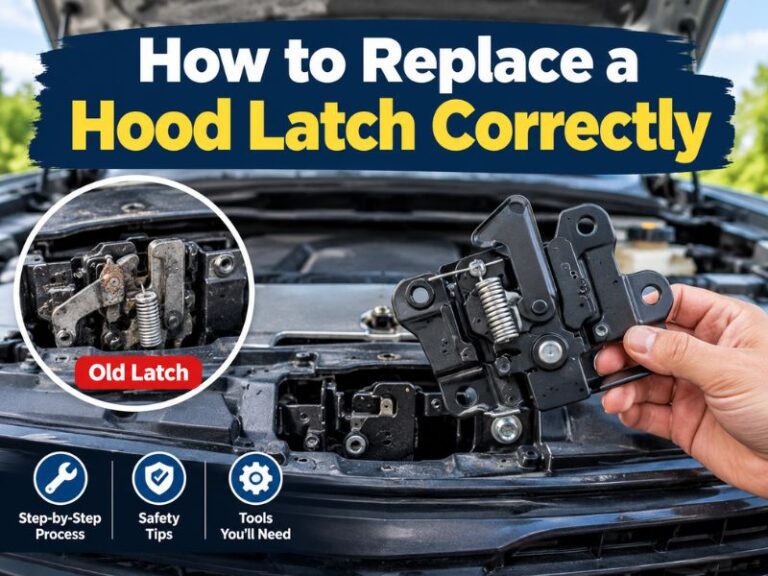
What Is Involved in Hood Latch Replacement?
The specific procedure varies between vehicles, but replacing a hood latch generally involves several common steps.
A typical process may include:
- Open and support the hood.
- Remove plastic radiator-support covers if necessary.
- Identify the latch position.
- Disconnect the hood release cable.
- Disconnect the hood latch sensor wiring if equipped.
- Mark the original latch position.
- Remove the mounting bolts.
- Remove the old latch.
- Position the replacement latch.
- Reconnect the release cable.
- Reconnect electrical wiring.
- Adjust latch alignment.
- Test the release action.
- Verify primary and secondary locking.
Correct final adjustment is particularly important.
The hood should close securely without requiring excessive force.
Can a Hood Latch Cause a Hood-Open Warning?
Yes, particularly when the hood latch sensor is integrated into the latch assembly.
The mechanical latch may close normally, but an electrical problem may cause the vehicle to continue reporting that the hood is open.
Possible causes include:
- Failed microswitch
- Corroded electrical connector
- Wiring damage
- Incorrect latch position
- Sensor contamination
- Internal latch sensor failure
The warning does not automatically mean the hood is mechanically unsecured, but the physical latch should always be checked.
Can a Hood Latch Affect Remote Start?
It can on vehicles that monitor hood position before enabling remote start.
Many remote-start systems are designed not to start the engine when the hood is open.
If a defective latch sensor incorrectly tells the vehicle that the hood is open, the remote-start system may refuse to operate.
The hood latch itself may still mechanically lock correctly.
Can a Hood Latch Cause the Car Alarm to Go Off?
On vehicles where the security system monitors the hood, an incorrect hood-position signal can contribute to unexpected alarm activation.
The alarm may interpret a sudden change from “closed” to “open” as unauthorized engine-compartment access.
Possible causes include the latch sensor, connector, wiring, or latch adjustment.
Other alarm sensors can produce similar symptoms, so an unexpected alarm should not automatically be blamed on the hood latch.
How to Help Prevent Hood Latch Problems
Basic inspection can help reduce the chance of latch-related problems.
Keep the Latch Clean
Periodically check the latch for dirt, leaves, heavy grease buildup, or road contamination.
Watch for Corrosion
Rust can gradually increase resistance before complete failure occurs.
Do Not Ignore Increased Release Effort
A hood release that becomes progressively harder to pull may indicate developing latch or cable resistance.
Avoid Repeatedly Slamming the Hood
If the hood requires unusual force to close, investigate the cause rather than repeatedly slamming it.
Check the System After Body Repairs
After grille, radiator-support, hood, bumper, or collision repairs, confirm that the striker and latch are properly aligned.
Frequently Asked Questions
What is a hood latch?
A hood latch is the mechanical locking assembly that captures the hood striker and keeps a vehicle’s hood securely closed until the release mechanism is operated.
What does a hood latch do?
A hood latch keeps the hood locked in the closed position, releases it when commanded by the hood release cable, and works with the secondary safety latch to help prevent unintended hood opening.
How does a hood latch work?
When the hood closes, the striker enters the latch and rotates an internal catch. A locking pawl holds the catch in position. Pulling the hood release cable disengages the mechanism and allows the striker to move upward.
What does a hood latch look like?
It usually looks like a compact metal assembly containing a catch, release lever, springs, mounting plate, and cable connection. Sensor-equipped latches may also have an electrical connector.
Where is the hood latch located?
Most hood latches are mounted near the front center of the vehicle on or around the upper radiator support, directly below the hood striker.
Is a hood latch the same as a hood lock?
The terms are commonly used interchangeably. Both usually refer to the mechanism that locks the hood to the vehicle.
What is the metal loop on the hood called?
The metal loop, pin, or hook that enters the latch is called the hood striker.
Why are there two hood latches?
Many vehicles have one primary latch plus a secondary safety latch. Some vehicles also use two separate primary latches because of hood size or design.
Why does my hood not latch?
Possible causes include a stuck latch, striker misalignment, broken spring, corrosion, damaged latch, or incorrect hood positioning.
Why does my hood not open?
A stuck latch, broken release cable, cable stretch, corrosion, misalignment, or excessive tension between the striker and latch can prevent opening.
Why does my hood release feel hard to pull?
Resistance may come from a binding cable, dirty or corroded latch, striker misalignment, or damaged release mechanism.
Why does my hood release handle feel loose?
A very loose handle can indicate a broken or disconnected hood release cable, broken handle, damaged cable fitting, or excessive cable slack.
Does every hood latch have a sensor?
No. Many modern vehicles have an integrated hood-position sensor, but others use a separate switch or no electronic hood monitoring.
What does a hood latch sensor do?
It tells the vehicle’s electronic system whether the hood is open or closed. This information may be used by the dashboard warning system, alarm, security system, or remote start.
Can a bad hood latch trigger an alarm?
A faulty integrated hood sensor or incorrect latch position can cause some security systems to interpret the hood as being opened and trigger an alarm.
Can a hood latch be adjusted?
Many vehicles allow limited adjustment of the latch, striker, hood bump stops, or hood position. Adjustment procedures vary by model.
How often should a hood latch be replaced?
There is normally no scheduled replacement interval. Replacement is usually based on condition, damage, wear, corrosion, or malfunction.
Is the hood latch connected to the hood release cable?
Yes. On most traditional systems, the release cable connects the interior hood release handle to a lever on the hood latch.
Is it safe to drive if the hood latch is broken?
If the primary latch cannot securely hold the hood closed, the vehicle should not be driven normally until the problem is corrected.
Conclusion
Understanding what is a hood latch helps explain how several important hood components work together. The hood latch is the mechanical locking assembly responsible for capturing the hood striker and keeping the hood securely closed while the vehicle is being driven.
When considering what does a hood latch do, its job extends beyond simply holding the hood down. It works with the hood release cable, interior release handle, secondary safety latch, striker, springs, and—in many modern vehicles—a hood latch sensor.
Knowing how does a hood latch work also makes common problems easier to understand. When the hood closes, the striker enters the latch and rotates an internal catch. A locking mechanism keeps that catch engaged until the driver pulls the release handle. The primary latch then releases, while the secondary safety catch keeps the hood partially secured.
For anyone wondering what does a hood latch look like or where is the hood latch located, it is usually a compact metal assembly mounted near the front-center radiator support, directly underneath the hood striker. Some vehicles use an offset or dual-latch arrangement instead.
Because the hood latch plays a direct role in securing the hood, changes such as difficult closing, increased release resistance, sticking, corrosion, or failure to remain locked should not be ignored. Keeping the latch clean, properly aligned, and operating smoothly helps the entire hood locking and release system remain reliable and safe.