What Is a Hood Lock on a Car? How Hood Latch Lock Systems Work
A car’s hood must remain securely closed while driving but still open easily when the engine compartment needs inspection or maintenance. The mechanical system responsible for holding the hood in place is commonly called the hood lock, hood latch, or hood latch assembly. Although the terminology varies among manufacturers, these terms often describe the mechanism that captures the hood striker and prevents the hood from opening unexpectedly.
So, what is a hood lock? A hood lock is the mechanical locking assembly that secures a vehicle’s hood to the body when the hood is closed. It normally works with a hood striker, release cable, interior hood release handle, springs, and a secondary safety latch. On many modern vehicles, the assembly may also contain a hood latch sensor that reports whether the hood is open or closed.
If you are wondering what is a hood lock on a car or how does a hood latch lock, the basic principle is straightforward: when the hood is pushed down, the striker enters the latch and causes the locking mechanism to rotate or engage. The primary latch captures the striker, while a secondary latch provides an additional layer of safety. Pulling the hood release cable reverses part of this process and allows the hood to open.
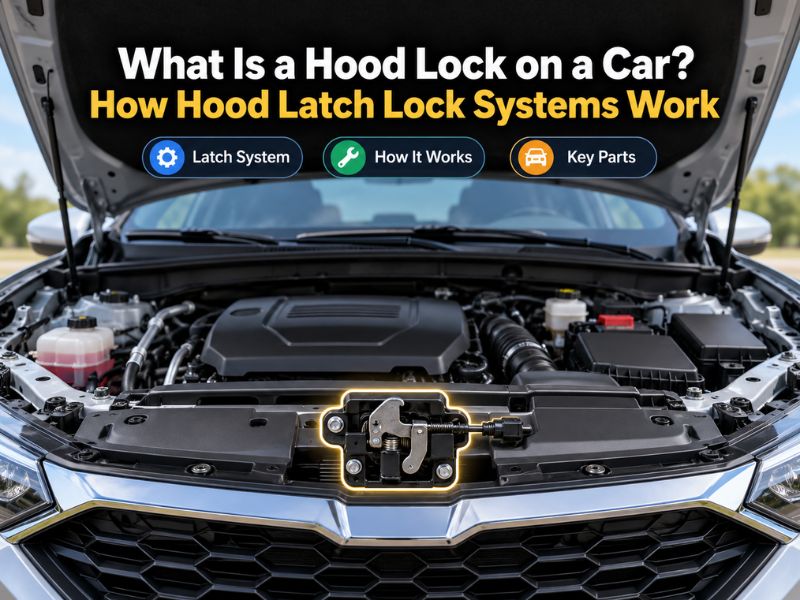
This pillar guide covers how hood locks work, their components, common designs, failure symptoms, causes of problems, maintenance, diagnosis, repair considerations, safety features, and their relationship with other hood components.
What Is a Hood Lock on a Car?
A hood lock is a mechanical device mounted near the front of a vehicle that holds the hood securely closed.
It is normally attached to the vehicle’s:
- Radiator support
- Front crossmember
- Upper tie bar
- Front body structure
A matching hood striker is usually mounted underneath the hood.
When the hood closes, the striker enters the hood lock. Internal parts inside the latch move around the striker and hold it in place.
The hood cannot normally be raised again until the driver operates the hood release system.
Quick Answer
A hood lock is the mechanism that catches and secures the hood striker when the hood closes. It prevents the hood from opening while driving and releases when the driver pulls the hood release handle.
In most vehicles, the hood lock includes a primary latch and is backed up by a secondary safety latch.
Is a Hood Lock the Same as a Hood Latch?
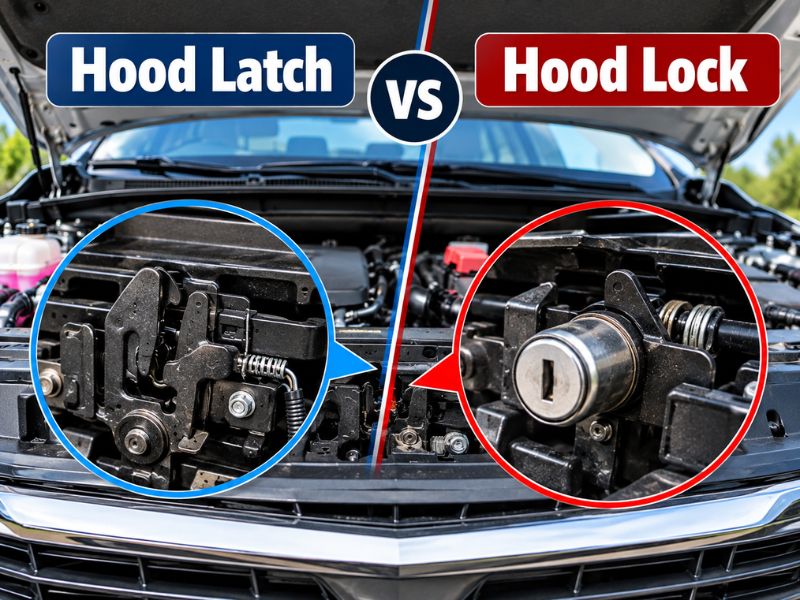
In everyday automotive terminology, hood lock and hood latch are often used to describe the same or closely related assembly.
Manufacturers may use terms such as:
- Hood lock
- Hood latch
- Hood lock assembly
- Bonnet lock
- Bonnet latch
- Hood catch
- Hood locking mechanism
However, terminology can sometimes differ.
The word latch generally refers to the mechanical mechanism that catches the striker.
The word lock may describe the entire mechanism that keeps the hood secured.
In most practical situations, someone searching for a replacement hood lock is likely referring to the hood latch assembly.
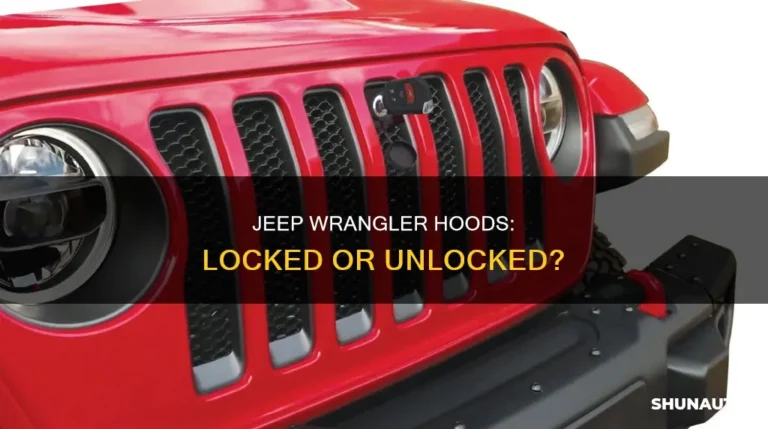
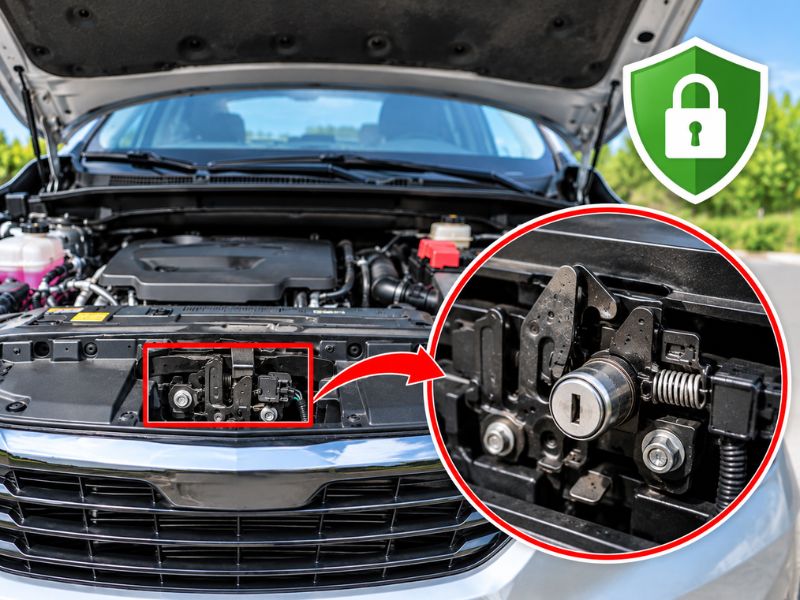
This should not be confused with an aftermarket anti-theft hood lock that may require a key or additional locking device.
Why Does a Car Need a Hood Lock?
The hood lock performs an important safety function.
At highway speeds, air moving around and beneath the vehicle can exert significant force on the hood. Without a reliable locking mechanism, the hood could lift suddenly and obstruct the driver’s view.
The hood lock is therefore designed to keep the hood securely attached to the front body structure.
Its primary functions include:
- Keeping the hood closed while driving
- Preventing unintended hood movement
- Allowing controlled hood release
- Holding the hood in correct alignment
- Working with the secondary safety latch
- Supporting hood-open monitoring on equipped vehicles
- Helping protect the engine compartment from unauthorized access
The locking system is simple compared with many electronic vehicle systems, but its function is safety-critical.
How Does a Hood Latch Lock Work?
To understand how does a hood latch lock, it helps to follow the hood from the fully open position until it is closed and locked.
The basic process is:
- The hood is lowered.
- The hood striker enters the opening in the latch.
- The striker pushes against an internal rotating catch.
- The catch rotates around the striker.
- A locking pawl holds the catch in position.
- The striker becomes trapped inside the latch.
- The hood is now held closed by the primary latch.
- The secondary latch provides additional protection.
- Pulling the interior release cable later moves the release lever.
- The locking pawl disengages and allows the primary latch to release.
The exact internal design varies, but most mechanical hood latches follow a similar principle.
How the Hood Locks When You Close It
When you lower the hood, the hood striker approaches the latch opening.
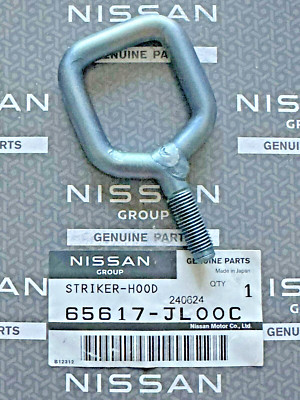
The striker is typically made from strong metal and may appear as:
- A U-shaped loop
- A metal pin
- A hook-like piece
- A reinforced metal bracket
As the striker enters the latch, it pushes against a movable catch.
The Latch Rotates Around the Striker
Inside the latch is a rotating component sometimes referred to as a:
- Catch
- Rotor
- Claw
- Pawl
- Latching plate
The striker forces this component to rotate.
Once the striker travels far enough, a spring-loaded locking piece engages the rotating catch.
The mechanism can no longer rotate backward freely.
The striker is therefore trapped inside the latch.
This is what keeps the hood closed.
Spring Tension Keeps the Mechanism Engaged
Small return springs and locking springs maintain pressure on the internal parts.
They help ensure that:
- The latch locks when the hood closes
- The release mechanism returns after use
- The locking pawl stays engaged
- The latch is ready for the next opening cycle
A broken, corroded, or weakened spring can interfere with proper hood operation.
How the Hood Lock Releases
Opening the hood begins from inside the vehicle.
The driver pulls the hood release handle, usually located near the lower dashboard or driver’s footwell.
The handle pulls a hood release cable.
That cable extends from the passenger compartment to the hood latch.
At the latch, the cable moves a release arm.
The release arm disengages the locking pawl from the primary catch.
Once the primary catch is released, the striker can move upward.
The hood usually rises slightly.
However, it remains partially secured by the secondary safety latch.
What Is the Secondary Hood Latch?
The secondary hood latch is an additional mechanical safety device that prevents the hood from opening completely when the primary latch is released.
After pulling the interior hood release lever, you normally need to reach under the front edge of the hood and operate a second lever.
Only then can the hood be raised completely.
Why the Secondary Latch Is Important
Imagine the primary hood latch accidentally released while the vehicle was traveling at speed.
Without a secondary mechanism, airflow could force the hood upward.
An open hood can:
- Block the driver’s forward view
- Damage the windshield
- Damage the hood hinges
- Damage the roof
- Create a serious road hazard
The secondary latch provides an additional barrier against this type of failure.
Main Parts of a Hood Lock System
A complete hood locking system involves several components working together.
Hood Latch Assembly
The hood latch assembly is the main mechanical locking mechanism.
It normally contains:
- Rotating catch
- Locking pawl
- Release lever
- Springs
- Mounting plate
- Secondary latch components
- Cable attachment point
Some modern assemblies also contain a hood latch sensor.
Hood Striker
The striker is attached to the underside of the hood.
Its job is to enter the latch and provide a strong point around which the latch can lock.
The position of the striker affects:
- Hood alignment
- Latch engagement
- Closing effort
- Hood height
If the striker becomes misaligned, the hood may become difficult to close or open.
Hood Release Cable
The hood release cable mechanically connects the interior release handle to the latch.
Pulling the handle creates cable tension.
This moves the latch release lever.
Hood Release Handle
The interior handle provides leverage for operating the cable.
It is commonly found:
- Below the steering wheel
- Near the driver’s kick panel
- Along the lower dashboard
- Beside the driver’s footwell
Secondary Safety Catch
The safety catch provides the second locking point that must be manually released from the front of the vehicle.
Latch Springs
Springs control the movement and return position of the latch components.
Hood Bump Stops
Although not technically part of the lock, rubber hood bump stops help support and position the hood when closed.
They can also create slight upward pressure that causes the hood to pop up when the main latch releases.
Where Is the Hood Lock Located?
The hood lock is usually located near the front center of the vehicle, directly below the hood striker.
A common location is the upper radiator support behind the grille.
Open the hood and look downward from the striker. The metal mechanism that receives the striker is usually the hood latch or hood lock.
Depending on the vehicle, it may be:
- Visible immediately
- Covered by plastic trim
- Behind the grille
- Mounted beneath the radiator cover
- Offset slightly from the center
Some vehicles use two separate hood latches rather than one central latch.
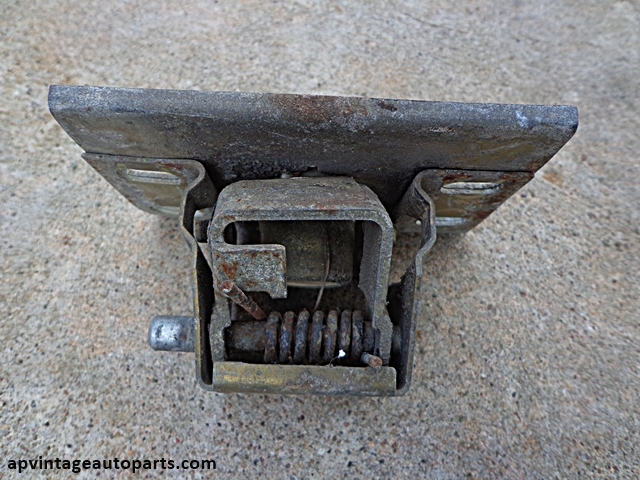
What Does a Hood Lock Look Like?
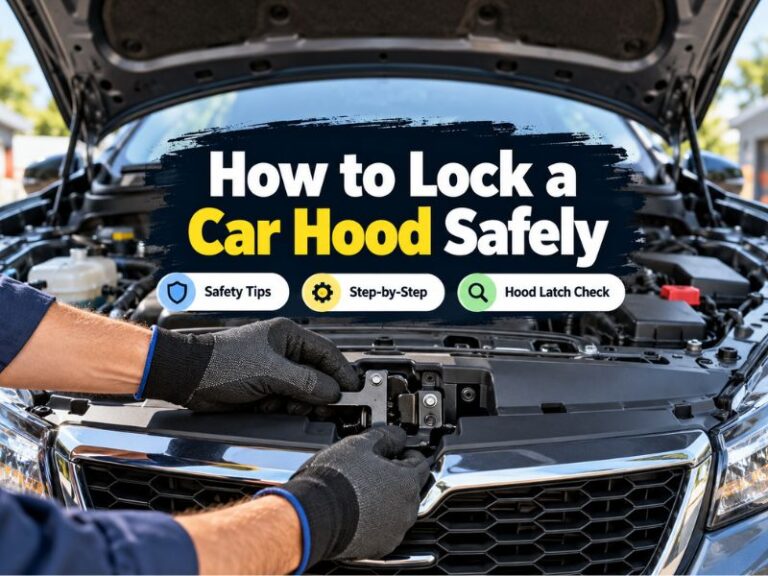
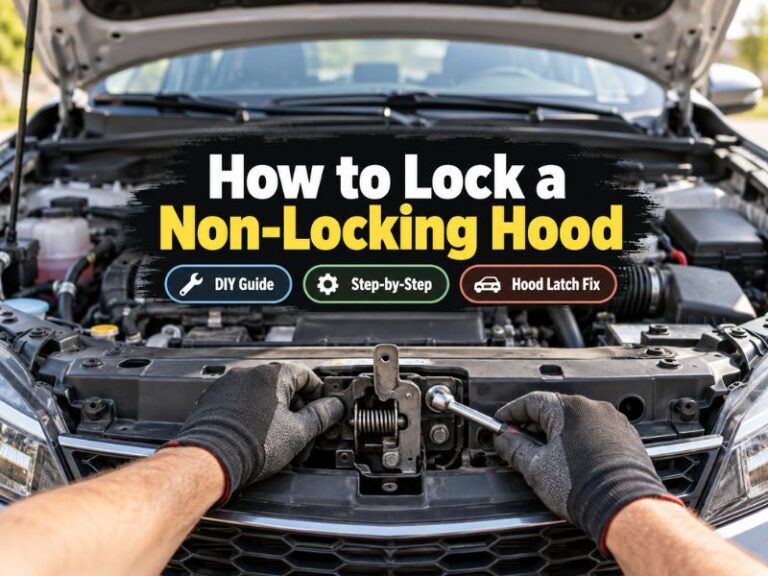
A typical hood lock looks like a compact metal mechanism attached to the radiator support.
Common visual features include:
- Stamped steel body
- Circular or hook-shaped opening
- Rotating metal catch
- Springs
- Cable connection
- Release lever
- Mounting bolts
On vehicles with electronic hood monitoring, you may also see:
- Electrical wires
- Plastic electrical connector
- Hood latch microswitch
- Sensor housing
The appearance varies considerably between vehicle models.
Single-Latch vs. Dual-Latch Hood Lock Systems
Not all vehicles use the same hood locking layout.
Single Hood Latch
Many passenger vehicles use one primary latch positioned near the center of the hood.
Advantages include:
- Simple design
- Fewer components
- Easier cable routing
- Lower manufacturing complexity
Dual Hood Latches
Some vehicles use separate latches on the left and right sides.
Dual-latch systems are sometimes found on vehicles with:
- Large hoods
- Wide front ends
- Particular aerodynamic designs
- Specific structural requirements
The hood release system must operate both latches simultaneously or in sequence.
Improper adjustment can result in one side releasing while the other remains locked.
Hood Lock vs. Hood Release Cable
These components work together but have different jobs.
The hood lock physically secures the hood.
The hood release cable operates the lock from inside the vehicle.
A simple way to visualize the system is:
Release Handle → Release Cable → Hood Lock → Hood Striker
Pulling the handle moves the cable.
The cable moves the hood lock release lever.
The latch releases the striker.
The hood opens.
A failure anywhere in this chain can make the hood difficult to open.
Hood Lock vs. Hood Latch Sensor
The hood latch sensor is another component associated with the hood locking system, but it serves an electronic function.
The hood lock mechanically secures the hood.
The sensor reports whether the hood is open or closed.
The sensor may communicate with:
- Body Control Module (BCM)
- Instrument cluster
- Factory alarm
- Remote-start system
- Anti-theft system
A sensor problem can cause a false hood-open warning even when the mechanical hood lock is working perfectly.
Likewise, a latch may have a mechanical problem even though its electronic sensor operates correctly.
Hood Lock vs. Hood Hinges
The hood hinges attach the rear portion of the hood to the body and allow it to rotate upward.
The hood lock secures the opposite end.
Together, they keep the hood positioned correctly.
Hood alignment can be affected by problems involving either system.
For example, bent hinges after a collision can change the hood’s position enough to prevent proper striker-to-latch alignment.
What Are the Signs of a Bad Hood Lock?
A damaged or worn hood latch can produce several symptoms.
Hood Is Difficult to Close
You may need to press down unusually hard before the latch captures the striker.
Possible causes include:
- Latch corrosion
- Dirt buildup
- Striker misalignment
- Bent latch
- Broken spring
- Hood alignment problem
Hood Will Not Stay Closed
This is a significant symptom.
If the latch does not hold the striker securely, possible causes include:
- Damaged latch teeth
- Broken locking pawl
- Incorrect striker position
- Broken spring
- Collision damage
- Excessive corrosion
A hood that cannot be securely latched should be addressed before normal driving.
Hood Will Not Open
Sometimes the latch remains locked even after the release handle is pulled.
Possible causes include:
- Stuck hood lock
- Corroded latch
- Broken release cable
- Stretched cable
- Damaged release lever
- Excessive hood pressure on the latch
- Misaligned striker
Hood Opens Only When Someone Pushes Down
If one person must press the hood while another pulls the release handle, there may be excessive tension between the striker and latch.
Possible causes include:
- Striker misalignment
- Hood adjustment
- Latch position
- Rubber bump-stop adjustment
- Minor collision damage
Hood Does Not Pop Up
The primary latch may release without the hood rising.
Possible causes include:
- Worn hood bump stops
- Latch friction
- Striker alignment
- Weak spring action
Release Lever Does Not Return
The latch release mechanism should normally return to its resting position.
Failure to return may indicate:
- Corrosion
- Broken return spring
- Cable binding
- Dirt
- Mechanical damage
Why Do Hood Locks Fail?
Hood locks are durable but operate in a harsh location at the front of the vehicle.
Dirt and Road Debris
Road dust, sand, grease, and debris can collect around the latch mechanism.
Over time, contamination can restrict moving parts.
Rust and Corrosion
Water exposure and road salt can cause corrosion.
Rust can increase friction between internal metal components.
Severe corrosion can weaken springs or locking surfaces.
Lack of Movement
Vehicles whose hoods are rarely opened can sometimes develop stiff latch mechanisms because corrosion and contamination remain undisturbed.
Worn Springs
Springs may weaken or break after years of repeated operation.
Collision Damage
Even a relatively minor front-end collision may move the:
- Hood
- Radiator support
- Hood striker
- Latch mounting point
This can prevent correct alignment.
Incorrect Adjustment
A latch or striker that has been improperly adjusted may not fully engage.
Excessive Force
Repeatedly slamming a misaligned hood can damage:
- Hood lock
- Striker
- Hood panel
- Mounting brackets
What Causes a Hood Lock to Stick?
A sticking hood lock commonly results from increased friction.
Frequent causes include:
- Rust
- Dried lubricant
- Dirt
- Bent latch parts
- Damaged cable
- Misaligned striker
- Broken spring
- Incorrect cable tension
A stiff latch can also place additional stress on the hood release cable and interior handle.
Therefore, a difficult hood release should not be ignored.
How Do You Know if the Hood Lock or Cable Is Bad?
Symptoms can overlap, but the feel of the interior release handle may provide useful clues.
Signs Pointing Toward the Release Cable
The cable may be the problem if:
- Interior handle feels extremely loose
- Handle suddenly has no resistance
- Cable is visibly broken
- Cable housing moves excessively
- Latch does not react when the handle moves
Signs Pointing Toward the Hood Lock
The latch may be the problem if:
- Cable clearly moves the release lever
- Latch feels stiff
- Hood has trouble locking
- Latch stays in the closed position
- Hood requires repeated attempts to close
- Mechanism is visibly rusty or damaged
A complete diagnosis should examine both components.
Can a Hood Lock Be Adjusted?
Many hood latch systems provide some adjustment.
Adjustment may involve repositioning the:
- Hood latch
- Hood striker
- Hood bump stops
- Hood itself
Small adjustments can change how deeply the striker enters the latch.
However, incorrect adjustment may prevent the latch from fully engaging or cause excessive hood tension.
The proper specifications and procedures vary by vehicle.
Should a Hood Lock Be Lubricated?
The hood latch contains moving metal surfaces, so appropriate maintenance can help maintain smooth operation.
The key goals are to keep the latch:
- Clean
- Free-moving
- Protected against corrosion
However, lubricant type and application recommendations can vary.
Excessive grease can attract dirt, while inappropriate products may not provide lasting protection.
Vehicle-specific service recommendations are preferable when available.
Can You Drive With a Bad Hood Lock?
A hood that is not securely latched presents a potential safety risk.
A malfunctioning hood lock could allow the hood to move or open unexpectedly.
Before driving, make sure:
- Primary latch fully captures the striker
- Hood cannot be lifted from the closed position
- Secondary safety latch operates correctly
- Hood sits properly aligned
If the hood does not stay securely closed, the latch system should be repaired before normal vehicle use.
A hood-open warning caused only by an electronic sensor is different from a mechanical latch failure, but the mechanical condition should still be verified.
Can a Hood Lock Be Repaired?
Whether repair is practical depends on the problem.
Minor issues may involve:
- Cleaning
- Correcting latch alignment
- Replacing a cable clip
- Restoring free movement
However, a complete hood latch assembly may need replacement when it has:
- Broken springs
- Damaged locking surfaces
- Severe corrosion
- Bent components
- Excessive wear
- Collision damage
Because the latch is responsible for securing the hood, severely damaged locking components should not be treated as permanently reliable after improvised repairs.
What Is Involved in Hood Lock Replacement?
Replacement procedures differ by vehicle, but the general process involves removing the old latch and installing the new assembly in the correct position.
Typical work may include:
- Opening and supporting the hood.
- Removing trim around the radiator support.
- Disconnecting the hood release cable.
- Disconnecting the hood latch sensor if equipped.
- Marking the original latch position.
- Removing latch mounting bolts.
- Installing the replacement latch.
- Reconnecting the cable.
- Reconnecting electrical wiring.
- Adjusting latch alignment.
- Testing the release mechanism.
- Confirming that the hood locks securely.
The hood should be tested carefully before normal vehicle operation.
Does a Hood Lock Have an Electronic Sensor?
Many modern vehicles integrate an electrical switch into the hood latch.
The hood latch sensor detects whether the latch is in the open or closed position.
Its information may be used for:
- Hood-open warning
- Factory security system
- Remote start
- Vehicle alarm
- Body electronics
This does not make the hood lock itself electronically operated.
In many vehicles, the latch remains mechanically operated by the release cable while the sensor only monitors its position.
Can a Hood Lock Affect Remote Start?
Indirectly, yes.
If the hood latch contains a sensor that incorrectly reports the hood as open, some remote-start systems will refuse to operate.
The restriction is a safety feature.
Remote-start systems generally need confirmation that the hood is closed before starting the engine remotely.
In this case, the mechanical hood lock may work correctly while the integrated sensor circuit has a fault.
Can a Bad Hood Lock Trigger the Car Alarm?
A mechanical latch problem alone may not activate the alarm.
However, vehicles with an integrated hood position sensor may interpret unexpected latch movement or an incorrect sensor signal as the hood being opened.
Possible symptoms include:
- Random alarm activation
- Hood-open warning
- Security-system errors
Wiring or sensor problems can create similar symptoms.
How Long Does a Hood Lock Last?
There is no standard replacement interval.
A hood latch can often last for many years or even the majority of a vehicle’s service life.
Its lifespan depends on factors such as:
- Climate
- Road salt
- Water exposure
- Maintenance
- Accident history
- Hood-opening frequency
- Latch alignment
- Component quality
Changes in operation are usually more useful than mileage for determining when inspection is necessary.
How to Help Prevent Hood Lock Problems
A few simple habits can improve reliability.
Keep the Latch Area Clean
Remove accumulated dirt and debris from around the latch.
Watch for Rust
Surface corrosion should not be allowed to progress until latch movement becomes restricted.
Do Not Ignore a Stiff Hood Release
A release handle that gradually becomes harder to pull may indicate increasing latch resistance.
Early attention may protect both the latch and cable.
Check Hood Alignment
A hood that suddenly sits higher on one side or requires excessive closing force may have an alignment problem.
Inspect After Front-End Work
After radiator, grille, bumper, body, or collision repairs, verify that the hood opens and closes normally.
Primary Hood Lock vs. Secondary Safety Latch
These two mechanisms serve related but different roles.
The primary hood lock is the main mechanism that keeps the hood closed during normal use.
The secondary safety latch acts as backup protection.
Pulling the interior release lever releases the primary latch.
The secondary latch remains engaged until manually operated.
This two-stage design explains why the hood normally pops up only a small amount after pulling the interior lever.
Is a Hood Lock an Anti-Theft Device?
The factory hood lock provides some basic resistance to unauthorized engine-compartment access because it normally must be released from inside the vehicle.
However, its primary purpose is securing the hood rather than serving as a dedicated high-security anti-theft device.
Additional aftermarket hood locks may be designed specifically for theft prevention.
These may use:
- Keyed locks
- Reinforced locking pins
- Additional cables
- Specialized security hardware
They are different from the standard factory hood latch.
Frequently Asked Questions
What is a hood lock?
A hood lock is the mechanical latch assembly that captures the hood striker and keeps the hood securely closed while the vehicle is being driven.
What is a hood lock on a car?
On a car, the hood lock is normally located near the front radiator support and connects with a striker mounted underneath the hood. It locks automatically when the hood closes.
How does a hood latch lock?
The striker pushes into a rotating latch catch when the hood closes. The catch rotates around the striker, and a locking pawl prevents it from rotating back until the hood release mechanism is activated.
Is a hood lock the same as a hood latch?
The terms are commonly used interchangeably. In most cases, both refer to the mechanical assembly that secures the hood.
Where is the hood lock located?
It is usually near the front-center radiator support directly below the hood striker. Some vehicles use two latches positioned farther apart.
What locks the hood closed?
The hood striker enters the latch, where a rotating catch and locking pawl secure it in place.
Why does the hood pop up after I pull the release?
Pulling the release cable disengages the primary latch. Hood bump stops or spring tension allow the hood to rise slightly while the secondary safety latch remains engaged.
Why does my hood not lock?
Possible causes include latch damage, striker misalignment, corrosion, a stuck latch mechanism, broken springs, or hood alignment problems.
Why will my hood not open?
Common causes include a sticking hood latch, broken release cable, cable stretch, corroded mechanism, or excessive pressure between the striker and latch.
Can the hood latch lock itself accidentally?
The latch can sometimes move into the locked position while the hood is open. If this occurs, the striker cannot enter normally until the latch is returned to the open position using the correct procedure for the vehicle.
Is the secondary hood latch part of the hood lock?
It may be integrated into the same assembly or mounted immediately beside it. Its role is to provide backup protection after the primary latch releases.
Does the hood lock have a sensor?
Many modern hood latch assemblies contain a hood-open sensor or microswitch, but older or simpler systems may use a separate switch or no electronic monitoring at all.
Can a hood lock cause a hood-open warning?
A mechanical latch position or an integrated sensor problem can cause the vehicle to report the hood as open even when it appears closed.
Can a hood lock stop remote start from working?
If the latch incorporates a hood-position sensor and the vehicle believes the hood is open, the remote-start system may be disabled.
Should a damaged hood lock be replaced?
A latch with damaged locking surfaces, broken internal parts, severe corrosion, or structural damage may require replacement because it is responsible for keeping the hood securely closed.
Conclusion
Understanding what is a hood lock makes the complete hood-opening and closing system much easier to understand. The hood lock, commonly called the hood latch assembly, is the mechanical mechanism that captures the hood striker and keeps the hood securely attached to the front of the vehicle.
When someone asks what is a hood lock on a car, the simplest explanation is that it is the device responsible for physically locking the hood in its closed position. The system usually includes a rotating catch, locking pawl, springs, release lever, hood striker, hood release cable, and secondary safety latch. Modern vehicles may also incorporate an electronic hood latch sensor into the same assembly.
Understanding how does a hood latch lock also helps explain many common hood problems. When the hood is lowered, the striker enters the latch and rotates the internal catch. A locking mechanism holds the catch in position until the driver pulls the interior hood release. The release cable then moves the latch lever, disengages the primary lock, and allows the hood to rise slightly. The secondary safety latch keeps the hood from opening completely until it is manually released.
Because the hood lock is a safety-related component, unusual symptoms such as difficult closing, excessive release-handle resistance, a hood that will not remain closed, sticking latch movement, or obvious corrosion should be investigated rather than ignored. Maintaining correct alignment and smooth latch operation helps the entire hood locking system work reliably and securely.