How Much Does It Cost to Replace a Hood Release Cable? Guide
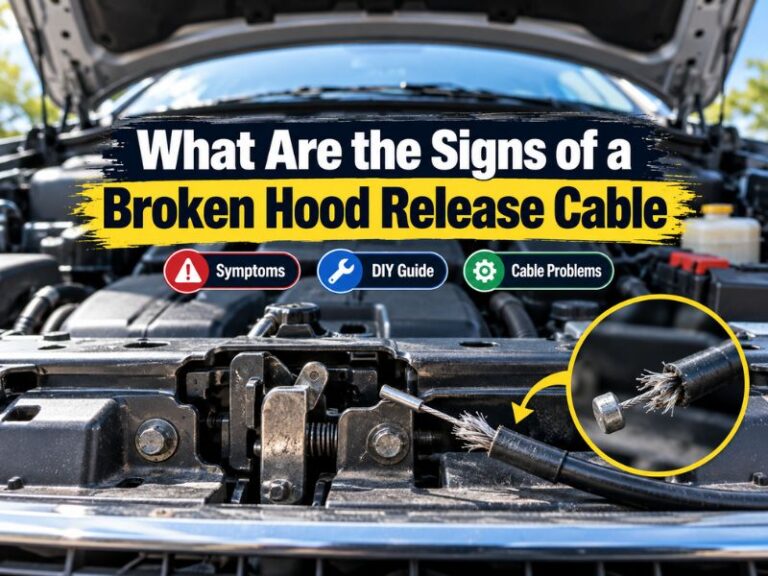
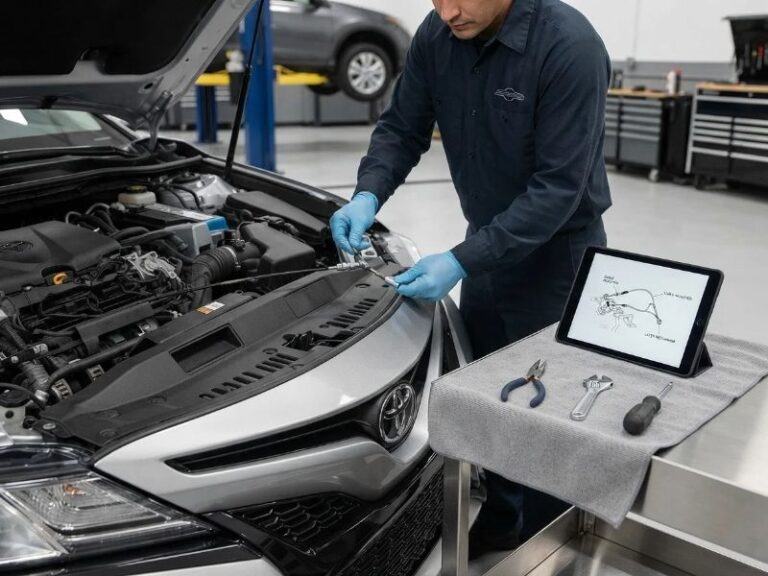
If pulling the hood release handle no longer opens the hood, the cable may be stretched, disconnected, seized, or completely broken. So, how much does it cost to replace a hood release cable? In the United States, a professional replacement commonly costs about $228 to $297, although the final bill can be lower or substantially higher depending on the vehicle and how difficult the cable is to access.
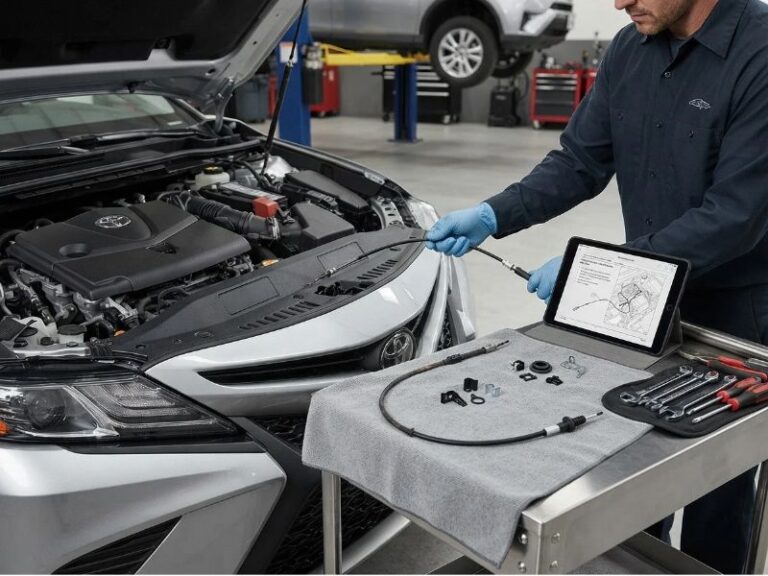
The cable itself is usually not the expensive part. Much of the repair cost comes from labor because a technician may need to route the new cable from the passenger compartment, through the firewall, and into the engine bay before connecting it to the hood latch.
Costs can also increase if the hood is already stuck closed. In that situation, the technician must first gain access to the latch without damaging the hood, grille, or surrounding parts.
This guide explains typical parts and labor costs, what affects the price, whether you can replace the cable yourself, and how to tell whether the cable is actually the problem.
How Much Does It Cost to Replace a Hood Release Cable?
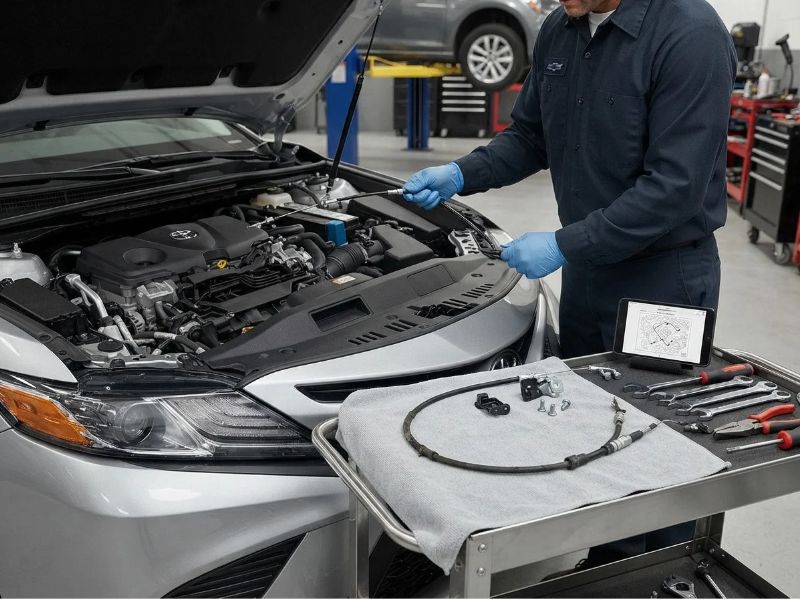
The typical professional cost to replace a hood release cable is approximately $228 to $297 for many vehicles.
A general cost breakdown looks like this:
| Expense | Typical Cost |
| Hood release cable | About 30–100 |
| Labor | About 150–220+ |
| Typical professional total | About 200–350 |
| DIY replacement | About 30–100+ |
Current nationwide repair estimates place the average hood release cable replacement at roughly 228–297, with approximately $80 going toward parts and 148–217 toward labor.
These figures are only general estimates. Luxury vehicles, complicated cable routing, dealership labor rates, and a hood that cannot be opened normally can push the repair above this range.
Hood Release Cable Replacement Cost Breakdown
Understanding where the money goes makes it easier to judge whether a repair estimate is reasonable.
Hood Release Cable Cost
The replacement cable itself is often relatively inexpensive compared with the labor required to install it.
Depending on the vehicle, you may find:
- Basic aftermarket cable: roughly 20–60
- Higher-quality or vehicle-specific cable: roughly 40–100
- Some OEM cable assemblies: potentially $100 or more
Certain vehicles use more complicated cable systems with multiple sections, junctions, handles, or release mechanisms.
For example, a vehicle may have a primary cable running from the interior handle and another cable connecting the release mechanism to one or more hood latches.
In that situation, the exact failed section needs to be identified before ordering parts.
Labor Cost
Labor is often the largest expense.
Expect approximately 150–220 or more in labor for a typical repair.
The technician may need to:
- Remove interior trim near the hood release handle
- Disconnect the original cable
- Route a replacement cable through the firewall
- Remove underhood trim
- Route the cable along the fender or radiator support
- Attach it to the hood latch
- Adjust the cable
- Verify that the hood opens and closes correctly
What looks like a simple cable replacement can therefore involve significant disassembly.
Read More: how often should you replace a hood release cable
Why Can Hood Release Cable Replacement Be Expensive?
The cable is mechanically simple, but its location makes replacement more complicated.
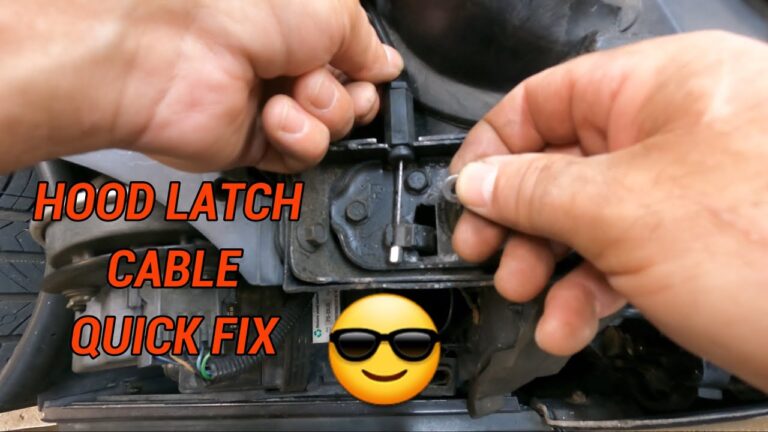
A hood release cable normally runs from the interior release handle to the front of the vehicle.
That means the cable may pass:
Behind dashboard or kick-panel trim → through the firewall → through the engine compartment → to the hood latch
Access to this route varies dramatically between vehicles.
On some cars, the technician can replace the cable relatively quickly.
On others, several trim pieces, splash shields, or engine-bay components may need to be removed.
Labor time is therefore one of the biggest factors influencing the final price.
What Affects Hood Release Cable Replacement Cost?
Several factors can move the repair cost above or below the average.
Vehicle Make and Model
Cable design varies between vehicles.
An older mainstream sedan may use a simple single cable that is inexpensive and relatively easy to replace.
Luxury vehicles and some SUVs may have more complicated latch systems or tighter access.
Models from brands such as Volvo, BMW, Mercedes-Benz, Audi, and Land Rover may also have higher OEM parts prices and labor rates.
OEM vs. Aftermarket Cable
An OEM cable is supplied by the vehicle manufacturer or its original supplier.
An aftermarket cable is produced by another manufacturer as a compatible replacement.
Aftermarket parts are often cheaper, but quality varies. Because a hood release cable is difficult to replace on many vehicles, choosing a well-made part can help avoid repeating the labor later.
Local Labor Rates
Automotive labor rates vary significantly across the United States.
A small independent repair shop in a lower-cost area may charge considerably less than a dealership in a major metropolitan area.
Hood Stuck Closed
A stuck hood can turn an otherwise routine cable replacement into a much more complicated repair.
If the cable has completely snapped while the hood is closed, the technician must somehow manually release the latch.
Depending on the vehicle, access may be possible:
- From underneath the vehicle
- Through the grille
- Behind a wheel-well liner
- Through another opening near the latch
If surrounding parts must be removed to reach the latch, labor costs can increase substantially.
Additional Damaged Components
The cable may not be the only problem.
The mechanic might also discover a worn:
- Hood latch
- Interior hood release handle
- Cable mounting bracket
- Cable retainer
- Hood striker
- Secondary safety latch
Replacing additional components increases both parts and labor costs.
How Long Does Hood Release Cable Replacement Take?
A typical replacement may require roughly 1 to 3 hours, depending on the vehicle.
Some straightforward cable systems can be repaired more quickly.
More complicated vehicles can take longer because the technician has to remove trim and carefully route the cable through the same path as the original.
If the hood cannot be opened, additional diagnostic and access time may be required before replacement even begins.
How Do You Know the Hood Release Cable Is Bad?
A hood that refuses to open does not automatically mean the cable needs replacement.
Several symptoms make a damaged cable more likely.
Release Handle Suddenly Feels Loose
A release lever that suddenly moves with little or no resistance is one of the strongest signs of a broken or disconnected cable.
Normally, you should feel tension as the cable operates the latch.
If the lever moves freely, the cable may have:
- Snapped
- Disconnected from the handle
- Disconnected from the latch
- Pulled out of its mounting point
You Have to Pull the Handle Very Hard
A cable that becomes stiff may be corroding or binding inside its outer housing.
A sticking hood latch can produce a similar symptom, so the latch should also be inspected.
Continuing to pull excessively hard can eventually break the cable or release handle.
Hood Opens Only After Several Attempts
An intermittent release can indicate a stretched cable, loose cable connection, or sticking latch.
The problem should be addressed before the cable completely fails and leaves the hood stuck closed.
Release Handle Does Not Return Normally
The handle should normally return after being pulled.
A handle that remains loose or does not return correctly may indicate cable, spring, handle, or latch problems.
Hood Release Cable vs. Hood Latch: Which Is Bad?
These two components are closely connected but perform different jobs.
The hood release cable transfers movement from the interior release handle to the latch.
The hood latch physically locks the hood in the closed position.
| Symptom | More Likely Cause |
| Interior handle has no resistance | Cable disconnected or broken |
| Handle feels unusually difficult to pull | Cable binding or latch sticking |
| Cable moves but latch does not release | Latch problem |
| Hood releases intermittently | Cable, adjustment, or latch problem |
| Hood will not stay closed | Latch or striker problem |
| Hood-open dashboard warning | Latch sensor or electrical problem |
| Hood opens when cable at latch is pulled manually | Cable or handle problem |
Proper diagnosis is important because replacing a good cable will not fix a defective latch.
How Much Does It Cost If the Hood Is Stuck Closed?
A hood that is already stuck closed may make the repair more expensive.
Instead of simply opening the hood and replacing the cable, the mechanic must first reach and release the latch manually.
The additional labor can bring the total repair into the 300–500 or higher range on vehicles where latch access is difficult.
The exact cost varies too much by vehicle to give a universal number.
In extreme cases, components around the grille or front bumper may need to be removed for access.
You should avoid aggressively prying on the hood because bending the hood or damaging the grille can turn a relatively inexpensive cable problem into an expensive body repair.
Can You Replace a Hood Release Cable Yourself?
Yes, replacing a hood release cable can be a DIY project, but it is generally an intermediate-level repair rather than one of the easiest vehicle maintenance jobs.
If you do the job yourself, your main expense may be only the replacement cable.
A DIY repair might cost approximately 30–100, depending on the part.
The challenging part is usually routing the cable correctly.
You may have to remove:
- Driver-side kick-panel trim
- Hood release handle
- Under-dash panels
- Engine-bay trim
- Wheel-well liner
- Cable clips or retainers
The new cable must also pass correctly through the firewall.
Incorrect routing can expose the cable to heat, sharp edges, or moving components.
Can You Repair a Broken Hood Release Cable Instead of Replacing It?
Usually, complete cable replacement is the better long-term solution.
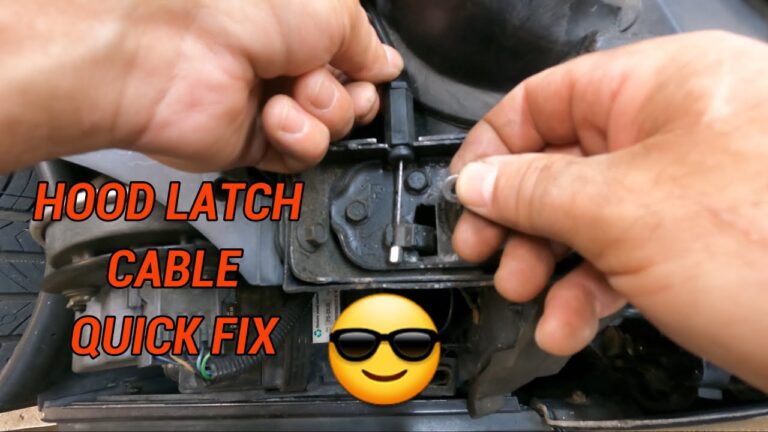
If the cable simply came disconnected from the interior handle or latch, reconnecting it may solve the problem.
However, a cable that is:
- Frayed
- Severely stretched
- Rusted
- Kinked
- Broken internally
- Damaged at the end fitting
should generally be replaced.
Trying to splice or permanently repair a damaged hood cable may leave you with another failure later.
Because hood access is necessary for routine maintenance and emergency repairs, reliability matters.
Should You Replace the Hood Latch at the Same Time?
Not automatically.
If the latch moves smoothly, locks securely, and releases normally when operated directly, replacing it may not be necessary.
However, a sticking latch can place excessive stress on the cable.
Before installing a replacement cable, the latch should be inspected and cleaned.
A technician may recommend replacing the latch if it is:
- Heavily corroded
- Mechanically damaged
- Seized
- Excessively worn
- Failing to release consistently
Fixing the latch at the same time may prevent the new cable from becoming damaged.
Hood Release Cable Replacement at a Dealer vs. Independent Shop
An independent repair shop will often be less expensive than a dealership for this repair.
A dealership may make sense when:
- The vehicle requires a specific OEM cable assembly
- The release system is unusually complicated
- Additional manufacturer-specific diagnosis is needed
- The vehicle is still covered by applicable warranty protection
For a conventional mechanical cable replacement, a reputable independent automotive shop can usually perform the repair.
When comparing estimates, ask whether the quoted price includes:
- Parts
- Labor
- Diagnostic time
- Opening a stuck hood
- Taxes and shop fees
- Hood latch adjustment
Two quotes that initially appear very different may include different amounts of work.
Is It Safe to Drive With a Broken Hood Release Cable?
A broken hood release cable normally does not cause the hood to open because the cable operates the release mechanism rather than holding the hood closed.
However, leaving the problem unrepaired creates another issue: you may be unable to access the engine compartment when you need to.
Without reliable hood access, you may not be able to:
- Check engine oil
- Add washer fluid
- Inspect coolant
- Access the battery
- Replace certain components
- Diagnose an overheating problem
- Perform emergency repairs
If the hood latch itself is damaged or the hood does not securely lock, the situation is more serious.
Do not drive the vehicle if the hood cannot be securely latched. An unsecured hood can open while driving and block your view of the road.
How to Reduce Hood Release Cable Problems
Hood cables can eventually wear out, but proper maintenance of the latch can reduce unnecessary strain on them.
Periodically inspect the hood latch for contamination and corrosion.
The latch should move freely without requiring excessive force from the interior release handle.
A small amount of appropriate automotive lubricant on the latch’s mechanical pivot points can help maintain smooth operation.
You should also investigate a release handle that becomes progressively harder to pull.
Replacing or servicing a failing component early is much easier than dealing with a broken cable after the hood becomes stuck closed.
FAQs About how much does it cost to replace a hood release cable
What is the average cost to replace a hood release cable?
A typical professional hood release cable replacement currently averages about $228 to $297 in the United States. Depending on the vehicle, shop labor rate, parts price, and accessibility, the total may fall around 200–350 or go higher.
How much does a hood release cable itself cost?
Many replacement hood release cables cost approximately 30–100, although some OEM or more complicated cable assemblies can cost more.
Labor often costs more than the cable itself.
How much does it cost to fix a broken hood release handle?
If only the interior handle is broken and the cable remains functional, the repair may be cheaper than replacing the complete cable.
The cost depends heavily on whether the handle is sold separately or comes as part of a cable assembly.
A technician should first determine whether the handle, cable, or latch actually failed.
Can a mechanic open a hood with a broken cable?
Usually, yes.
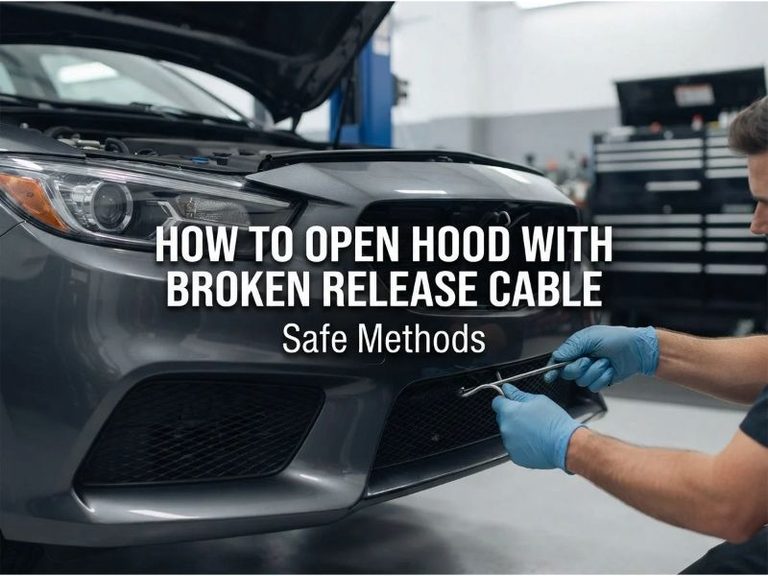
A mechanic may be able to manually operate the latch from underneath the vehicle, behind the grille, through the wheel-well area, or by accessing the remaining cable.
The method depends entirely on vehicle design.
If access requires significant disassembly, the additional labor will increase the repair cost.
Is replacing a hood release cable difficult?
The mechanical concept is simple, but installation can be moderately difficult.
Routing the cable from inside the cabin through the firewall and into the engine compartment is typically the hardest part.
Some vehicles require considerable trim removal.
How long can I drive with a broken hood release cable?
The cable itself does not normally hold the hood closed, so a broken release cable does not necessarily mean the hood is unsafe.
However, you should repair it soon because you need reliable access to the engine compartment for inspections, maintenance, and emergencies.
If the hood latch itself does not securely hold the hood closed, do not drive the vehicle.
Why is my hood release handle hard to pull?
A stiff handle may be caused by a binding cable, corrosion inside the cable housing, poor cable routing, or a dirty and sticking hood latch.
Have the system inspected before pulling harder because excessive force can break the handle or cable.
Is a hood release cable expensive to replace on a luxury vehicle?
It can be. Luxury and European vehicles may have more complicated cable routing, multiple latch mechanisms, more expensive OEM parts, or higher labor rates.
As a result, replacement may cost significantly more than the general nationwide average.
Conclusion
So, how much does it cost to replace a hood release cable? For many vehicles in the United States, expect approximately $228 to $297 for a typical professional repair, with broader real-world costs often around 200–350. The replacement cable itself is usually relatively inexpensive; labor makes up much of the bill because the cable must be carefully routed between the interior release handle and hood latch.
Costs can rise if the hood is already stuck closed, the vehicle has a complicated dual-latch system, or the latch and handle also require replacement. Before approving the repair, make sure the shop confirms whether the actual problem is the cable, release handle, or hood latch so you pay only for the parts that genuinely need to be replaced.